




The Centre has advised the Assam state government to go for culling of pigs affected by the African Swine Fever (ASF).
- It has been advised to divide the affected areas into zones and go for culling accordingly.
- The disease was first reported in November-December, 2019 from the areas of China bordering Arunachal Pradesh.
- A few organized piggeries
in Assam have been affected and the possible carrier could be humans.
- However, there is no confirmation on humans being the carrier of the virus.
- Earlier in April, there were reported deaths of pigs due to the Classical Swine Fever (CSF).
- ASF and CSF are different from Swine Flu (H1N1) and do not affect humans.
- CSF can be prevented by proper vaccination but there is no vaccination for ASF. Culling of the affected pigs is the only option.
African Swine Fever
- It is a highly contagious and fatal animal disease that infects and leads to an acute form of hemorrhagic fever in domestic and wild pigs.
- It was first detected in Africa in the 1920s.
- The mortality is close to 100% and since the fever has no cure, the only way to stop its spread is by culling the animals.
- ASF is not a threat to human beings since it only spreads from animals to other animals.
- ASF is a disease listed in the World Organisation for Animal Health (OIE) Terrestrial Animal Health Code and thus, reported to the OIE.
Transmission and spread: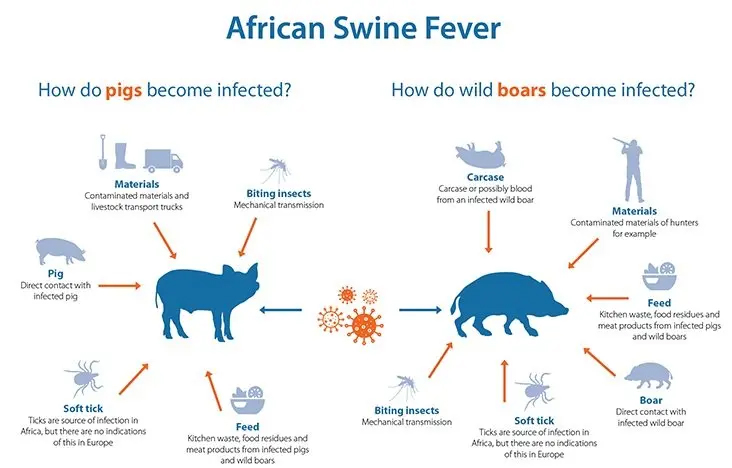
- The epidemiology of ASF is complex and varies depending on the environment, types of pig production systems, the presence/absence of competent tick vectors, human behaviour, and the presence/absence of wild pigs.
- Direct contact with infected domestic or wild pigs: This transboundary animal disease (TAD) can be spread by live or dead pigs, domestic or wild, and pork products.
- Indirect contact, through ingestion of contaminated material (e.g. food waste, feed, or garbage).Contaminated fomites, or biological vectors (soft ticks of the genus Ornithodoros) where present.
World Organisation for Animal Health
- OIE is an intergovernmental organisation responsible for improving animal health worldwide.
- In 2018, it had a total of 182 Member Countries. India is one of the member countries.
- OIE standards are recognised by the World Trade Organization as reference international sanitary rules.
- It is headquartered in Paris, France.
Clinical symptoms of ASF:
- Acute formsof ASF are characterised by high fever, depression, anorexia and loss of appetite, haemorrhages in the skin (redness of skin on ears, abdomen and legs), abortion in pregnant sows, cyanosis, vomiting, diarrhoea and death within 6-13 days (or up to 20 days).Mortality rates may be as high as 100%.
- Different types of pig may have varying susceptibility to ASF virus infection. African wild suids may be infected without showing clinical signs allowing them to act as reservoirs.
Public health risk:
- ASF is not a risk to human health as it is relatively harmless.
Prevention and control:
- Currently there is no approved vaccine for ASF.