



 The discovery of Gupta era temple in Etah district of Uttar Pradesh by Archaeological Survey of India (ASI) has put back the focus on the shankhalipi script.
- The script in the temple was deciphered as saying, ‘Sri Mahendraditya’, the title of Kumaragupta I of the Gupta dynasty.
- Shankhalipi or shell-script is a term used to describe ornate spiral characters assumed to be Brahmi derivatives that look like conch shells or shankhas.
- They are found in inscriptions across north-central India and date to between the 4th and 8th centuries.
- Shankhalipi is found to be engraved on temple pillars, columns and rock surfaces.
- Both Shankhalipi and Brahmi are stylised scripts used primarily for names and signatures.
- The inscriptions consist of a small number of characters, suggesting that the shell inscriptions are names or auspicious symbols or a combination of the two.
Chronology
- The script was discovered in 1836 on a brass trident in Uttarakhand’s Barahat by English scholar James Prinsep.
- He was the founding editor of the Journal of the Asiatic Society of Bengal.
- Later, two more similar scripts were found at Nagarjuna group of caves in the Barabar Hills near Gaya, Bihar.
- Prominent sites with shell inscriptions include:
- Mundeshwari Temple in Bihar
- Udayagiri Caves in Madhya Pradesh
- Mansar in Maharashtra
- Some cave sites of Gujarat and Maharashtra
- Also reported in Indonesia’s Java and Borneo.
- The attempts to decipher shell script have not been successful.
- No such inscriptions with dates or numbers have been reported so far even as their chronology can be determined by the objects on which they are written.
- The stairway includes Shankhalipi inscriptions which state ‘Sri Mahendraditya,' the title of the Gupta emperor Kumaragupta I.
- Shankhalipi is an elaborate, stylized ancient script that was employed for names and signatures between 4th and 8th century CE.
- There were two ornamental pillars that were near to one other and had human sculptures on them.
- The writing discovered on the Etah skeletons has previously been discovered on a horse statue in Lakhimpur Kheri.
- The bones were dated to Kumaragupta 1's reign.
- The Etah ruins are the third Gupta era structure temple discovered so far.
- Earlier, only two structural temples were found — Dashavatara Temple in Deogarh and Bhitargaon Temple in Kanpur Dehat.
- Kumaragupta 1 was the son and successor of Chandragupta II.
- Reign: 414 - 455 AD
- Adopted the titles of ‘Shakraditya’ and ‘Mahendraditya’.
- Performed ‘Ashvamedha’ sacrifices.
- He laid the foundation of Nalanda University which emerged as an institution of international reputation.
- These are – Karandanda, Mandsor, Bilsad inscription (oldest record of his reign) and Damodar Copper Plate inscription.
- Gupta period marks the beginning of Indian temple architecture.
- Manuals were written regarding how to form temples.

- Square building with flat roof
- Shallow pillared porch
- Sanctum (garbhagriha) at the center of the temple
- A single entrance & porch (Mandapa)
- Mandapa appears to originate 1st from here
- Example- Vishnu Varaha temples in (MP)
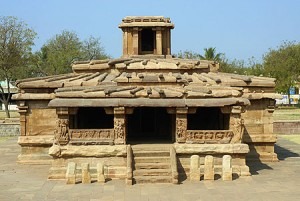
- Square temple with a squat tower (shikhara) above
- Pillared approach, a high platform at the base
- Examole- Ladkhan Temple at Aihole (Karnataka)
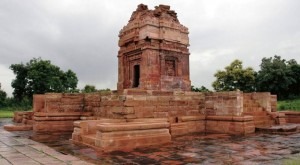
- An elaboration of the first type
- Addition of an ambulatory (paradakshina) around the sanctum
- Most unique achievement of this stage was “Curvilinear tower” i.e., “Shikhara”.
- “Nagara Style” of temple making.
- Example- Dasavatara temple (Deogarh, Jhansi)
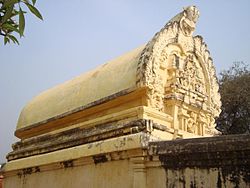
- Rectangular temple with an apsidal back
- Barrel-vaulted roof above
- Example- Kapoteswara temple at Cezarla (Andhra Pradesh)
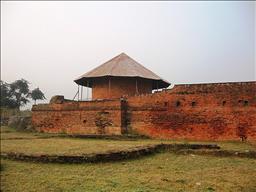
- Circular temples with shallow rectangular projection
- Example- Maniyar Math shrine at Rajgir, Bihar