



RUBIN MUSEUM TO RETURN NEPALESE RELICS THOUGHT TO HAVE BEEN STOLEN.
Rubin Museum will return Nepalese relics thought to have been stolen, one relic being the upper section of a 17th century wooden torana form a temple complex in Patan called the Yampi Mahavihara.

 Inter-State River Water Disputes Act, 1956

 Genesis:


 World Employment and Social Outlook Trends (WESO Trends) 2022:
 Yellow Revolution:
 India Post Payments Bank (IPPB):
- Torana is a free-standing ornamental or arched gateway for ceremonial purposes.
- It is seen in the Hindu, Buddhist and Jain architecture of the Indian subcontinent, Southeast Asia and parts of East Asia.
- It is also referred to as Vandanamalikas.
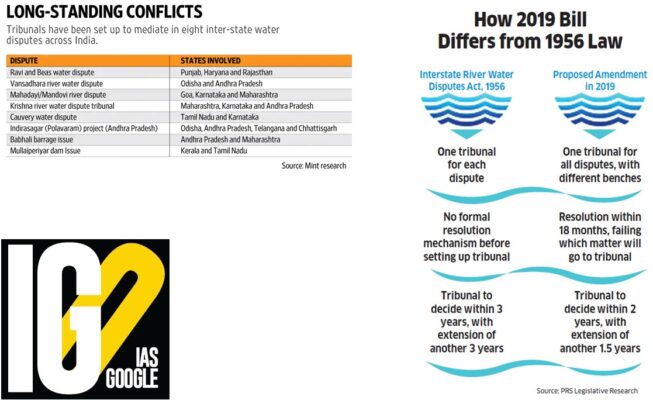
Inter-State River Water Disputes Act, 1956
- The Interstate River Water Disputes Act, 1956 (IRWD Act) is an Act of the Parliament of India enacted under Article 262of Constitution of India.
- Article 262(1) provides that Parliament may adopt legislation for the settlement of disputes or complaints concerning the use, distribution or control of transboundary waters in a river or river valley.
- The Act provides for the adjudication of disputes relating to waters of inter-state rivers and river valleys.
- The Act empowers Central government to set up a Tribunal for dispute resolution on the request of a state government.
- The Tribunal must give its decision within three years, which may be extended by two years.
- The decision of the Tribunal must be published by the central government in the official gazette.
- The central government maintains a data bank and information system at the national level for each river basin.
- Limited role of Centre:
- The centre can act on the dispute, only on the request of the state.
- A state cannot directly approach the tribunal:
- The state has to request the Centre to refer an interstate river dispute to a tribunal.
- Delays in the procedures:
- The multiplicity of tribunals has led to an increase in bureaucratic delays, and possible duplication of work.
- Thus, there is a dire need for speedy disposal of such disputes with a permanent institutional mechanism.
- Disenchantment with provisions:
- There is no time limit for publishing the reports, and the states have no remedy.
- The unsatisfactory adjudication leads to exaggerated claims by both the dispute parties.
- The existing provisions do not rule out recourse to negotiations, or mediation or reconciliation.
- There is no provision to ensure that an award once given is duly implemented.
- Lack of legal provisions in the Act has resulted in the creation of more disputes.
- The Inter-State River Water Disputes (Amendment) Bill, 2019 amends the Inter-State River Water Disputes Act, 1956.
- The bill provides for the setting up of a Disputes Resolution Committee (DRC)to resolve the dispute amicably.
- The states concerned would be encouraged to come to a negotiated settlement through a Disputes Resolution Committee (DRC).
- The central government will set up an Inter-State River Water Disputes Tribunal, for the adjudication of water disputes.
- It binds the Centre to set up DRC to amicably resolve the issue by negotiations in one year.
- The Bill provides that the central government will appoint or authorise an agency to maintain data bank.
- It was illegally removed from a temple in Lokhari, Banda, Uttar Pradesh in sometimes the 1980s and traded in the markets of London (UK).
- Yoginis are powerful female divinities associated with the Tantrik mode of worship.
- Often, they are believed to have 64 appearances or Group of 64 Yoginis, having infinite powers.
- The Goat Head Yogini is one of the 64 Yoginis.
Genesis:
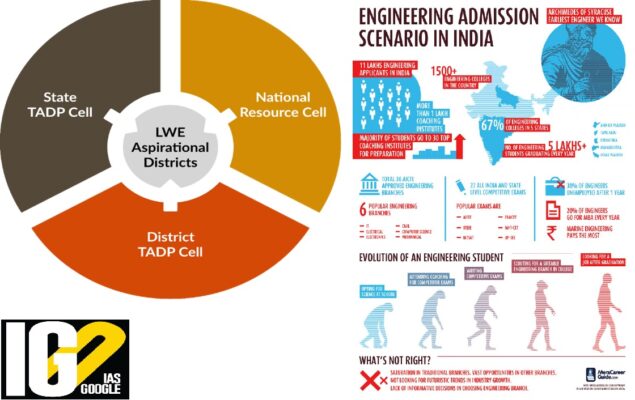
- In 2019, IIT-Hyderabad had advised the government to put a moratorium on granting approvals to new engineering colleges for two years, starting 2020.
- Government of India launched the ‘Transformation of Aspirational Districts’ initiative in 2018.
- Aim: To improve India's ranking under Human Development Index, raising living standards of its citizens and ensuring inclusive growth of all.
- A total of 117 Aspirational districts have been identified by NITI Aayog.
- Convergence of scheme resources implemented with Left Wing Extremism (LWE) funds.
- Real-time progress tracking of the district plans.
- Coordinated efforts, community action, and other development interventions.
- Integrated support from Central Ministries, State Governments, and District Administrations.
- Focus Area: Health & Nutrition (30%), Education (30%), Agriculture & Water Resources (20%), Financial Inclusion & Skill Development (10%), and Basic Infrastructure (10%).
- At the event, the MoHUA also launched Season-2 of India Cycles4Change and Streets for People Challenges.
- Both the Streets for People Challenge and the Nurturing Neighbourhoods Challenge are the competition between Smart cities under the Smart Cities Mission (SCM).
- SCM was launched in 2020, since then these challenges are being conducted among the selected smart cities, in a phase-wise manner.
- It is a challenge for a paradigm shift from car-centric roads to people-centric streets, by prioritizing them for pedestrians.
- The National Urban Transport Policy, 2006also has a similar vision.
- The challenge was conducted with technical support from the Institute for Transportation and Development Policy (ITDP India).
- Winner cities will be awarded Rs. 50 lakhs each by MoHUA.
- MoHUA announced winner cities for this challenge in collaboration with the Bernard van Leer Foundation (BvLF) and technical partner World Resources Institute (WRI) India.
- The Challenge is a 3-year phased initiative aimed at shaping early childhood-friendly neighborhoods in Indian cities.
- Under it, included activities are: Creation of public spaces in slums, age-appropriate play areas, enhanced outdoor waiting spaces around primary health centers and anganwadis, amenities for caregivers etc.
- SC asked the Union government to prepare a model to implement the Community Kitchen scheme across the country and for providing additional food grains to states to run it.
- A Community Kitchen is a group of people who meet on a regular basis to plan, cook and share healthy, affordable meals.
- National Nutrition Mission (NNM) or the POSHAN Abhiyaan, was launched on International Women’s Day 2018.
- It targets children, pregnant women and lactating mothers, aiming to reduce stunting, undernutrition, anemia and low birth weight babies.
- Stunting: It is defined as low height-for-age. It is the result of chronic or recurrent undernutrition. In 2019-21, 35.5% of children below five years were stunted.
- Undernutrition: It is a deficiency of calories or of one or more essential nutrients.
- Anemia: It is a condition in which person lack enough healthy red blood cells to carry adequate oxygen to body's tissues. Females (54.6%) were more anaemic than males (45.1%).
- low birth weight: It is used to describe babies who are born weighing less than 5 pounds, 8 ounces (2,500 grams).
- It uses Lives Saved Tool, also known as LiST, to gather results on increased interventions of maternal, newborn and child health, and nutrition.
- NNM targets to reduce stunting, under- nutrition, anemia (among young children, women and adolescent girls) and reduce low birth weight by 2%, 2%, 3% and 2% per annum respectively.
- National Development Council launched the National Food Security Mission in 2007.
- Aim: To increase the production of rice, wheat and pulses through:
- Area expansion and productivity enhancement.
- Restoring soil fertility and productivity
- Creating employment opportunities
- Enhancing farm level economy.
- Programme in India began in 2017 to improve agriculture, health and nutrition.
- Programme Focused on Developing farm equipment, revamping the farming system, setting up genetic gardens for biofortified plants and beginning zero hunger training.
- Aim:
- Decrease child stunting for children 2 years and younger
- Ensure access to food all year round
- Create stable food systems
- Increase small farmer productivity and income
- Eliminate food waste
- It is started by The Food Safety and Standards Authority of India.
- The program stands on the foundation of regulatory capacity building, collaborative and empowerment approach.
- Aim: to encourage communities to eat healthy, safe and sustainably.
- Food fortification is a process of nutrient supplementation chemically, biologically or physically.
- In India, food fortification began in the 1950s with vegetable oil fortification and salt iodization.
- In the 2000s, the government introduced fortification of other commodities such as rice and wheat.
- Under these, five kilograms of food grains were provided per person per month to around 800 million beneficiaries.
- In addition to food grains, one kg of pulses has been provided to 194 million households per month for the period April to November 2020.
- The government provided about 800 thousand tonnes of additional food grains to migrants / stranded migrants.
- Each person received five kg grain per month during May and June 2020.
- India ranks 101st out of the 116 countries in 2021.
- Prepared annually by Concern Worldwide and Welthungerhilfe.
- India is among the 47 countries most likely to not reach the zero-hunger goal.
- GHI score decreased to 27.5 in 2021 from 38.8 points in 2000.
- However, India has the highest child wasting in the world that affects 17.3 per cent of its children.
- The proportion of undernourished in the population and the under-five child mortality rate are now at relatively low levels.
World Employment and Social Outlook Trends (WESO Trends) 2022:
- WESO Trends is a comprehensive study on employment data of the world.
- The report provides detailed labor market estimates for 2022 and 2023.
- Global unemployment rate to remain above pre-Covid-19 levels until at least 2023.
- For the year 2022, the unemployment level is estimated at 207 million.
- It was around 186 million in 2019. (Around 1.2% difference)
- The European and North American nations are recovering well.
- But, regions of Southeast Asia, Latin America, and the Caribbean have shown lenient recovery.
- At the national level, high-income Nations are faring the best, while lower-middle-income Nations are faring the worst.
- In 2022, the employment-to-population ratio is estimated to be 55.9%. This is 4% below the 2019 level.
- During 2019 and 2020, the global labor force participation rate has fallen by 2%. It is projected to recover only partially to just below 59.3% by 2022.
- In 2022, there will be a working-hour deficit equivalent to 52 million full-time jobs.
- Rebuilding the economy to address systemic and structural inequalities. It also includes a sustainable developmental approach.
- Implementation of four pillars through Fiscal Policy: inclusive economic growth and development; protection of all workers; universal social protection; and social dialogue.
- Capacities of public administrations and employers’ and workers’ organizations to participate in Social dialogue are required to be strengthened.
- Established: 1919 (187 members)
- Headquarters: Geneva, Switzerland
- Objective: Labor Empowerment
- ILO is the first and oldest Specialized Agency of the United Nations (UN).
- ILO brings together governments, employers, and workers. ILO is working in the field of labor empowerment. For this, it has framed International Labor Standards.
- World Employment and Social Outlook
- World Employment and Social Outlook: Trends
- World Social Protection Report
- Global Wage Report
- Out of these 8, India has ratified 6 ILO conventions.
- The remaining two unratified conventions include:
- Freedom of Association and Protection of the Right to Organise Convention, 1948 (No. 87)
- Right to Organise and Collective Bargaining Convention, 1949 (No. 98).
Yellow Revolution:
- The revolution launched in 1986- 1987.
- Aim: To increase the production of edible oil, especially mustard and sesame seeds to achieve self-reliance.
- Yellow Revolution targets nine oilseeds that are groundnut, mustard, soybean, safflower, sesame, sunflower, niger, linseed and castor.
- India came up with the Oil Technological Mission in 1986 to ensure success for yellow revolution.
- Farmers were given facilities like fertilizers and pesticides for the crops, as well as irrigation etc.
- Other facilities included the transportation facility and storage. This was required to make the revolution successful.
- Boards such as the National Dairy Board (NDB)were given many important responsibilities to enhance the production of oilseed.
- The NDB took the responsibility to increase the production of groundnut oil in Gujarat.
- National Oilseeds and Vegetable Oils Development Board was setup to enhance the production of oilseeds in other areas as well.
- Oilseeds Production Trust came in India to boost the production of the four oilseeds, mainly, mustard, groundnut, soybean, and sunflower.
- The Yellow revolution had the implantation of hybrid mustard and sesame seeds which significantly increased the production of edible oil.
- There was use of improved technology for oil production.
- The Revolution gave rise to a new era with blooming sunflowers in the state of Punjab.
- The mustard plant is an important oilseed crop of India.
- Mustard seed is used as a spice.
- Mustard seeds are a rich source of oil and protein.
- Mature mustard plants grow into shrubs.
- Mustard seeds generally take eight to ten days to germinate if placed under the proper conditions.
- Yellow mustard has a plant maturity of 85 to 90 days.
- Mustard grows well in temperate regions.
- It requires temperatures between 10°C to 25°C.
- The mustard crop is produced in the areas receiving 625 -1000 mm annual rainfall.
- Mustard farm does not tolerate freeze, so it requires a clear sky with frost-free conditions.
- Mustard plantations relatively require moist soil.
- It can be raised in wide varieties of soils that range from light to heavy loamy soils.
India Post Payments Bank (IPPB):
- It has been established under the Department of Posts, Ministry of Communication by with 100% equity owned by Government of India.
- Launched in: 2018.
- Aim: To build the most accessible, affordable and trusted bank for the common man in India.
- Mandate: To remove barriers for the unbanked and under-banked and reach the last mile leveraging the postal network.
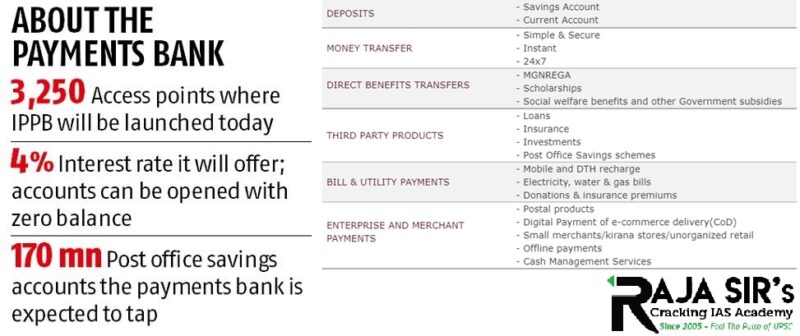
- While opening a bank account in the bank one can choose from three types options: Regular Account or 'Safal', Basic Savings Bank Deposit Account (BSBDA) or 'Sugam', and BSBDA Small or 'Saral'.
- All three are zero balance accounts (they do not require the bank account holder to maintain any specific balance every month).
- It provides paperless and cashless banking services in a simple and secure manner to the customers.
- It delivers affordable banking solutions through intuitive interfaces available in 13 languages.
- Account: The bank offers savings and current accounts up to a balance of ₹1 Lakh.
- QR Card: Customers can use QR code payments eliminating the need to remember account numbers, PINs and passwords.
- Unified Payments Interface
- Immediate Payment Service
- National Electronic Funds Transfer
- Real-time gross settlement
- Bharat BillPay
- Direct Benefit Transfer
- RuPay Debit Card
- AEPS (Aadhaar Enabled Payment Service)