



India has launched a nationwide crackdown on fake ORS (Oral Rehydration Solution) products following widespread concerns about misleading health claims and public health risks.
FSSAI’s Ban on Misleading “ORS” Labels
- On October 14, 2025, the Food Safety and Standards Authority of India (FSSAI) issued a directive prohibiting all food and beverage companies from using the term “ORS” on product names, trademarks, or labels—even with a prefix or suffix—unless the formulation matches the World Health Organisation (WHO)-approved oral rehydration solution formula.
- The move came after investigations revealed that many companies were marketing sweetened, fruit-flavored beverages and powders as “ORS drinks,” misleading consumers into believing they were medically approved rehydration products.
Composition and Consumer Deception
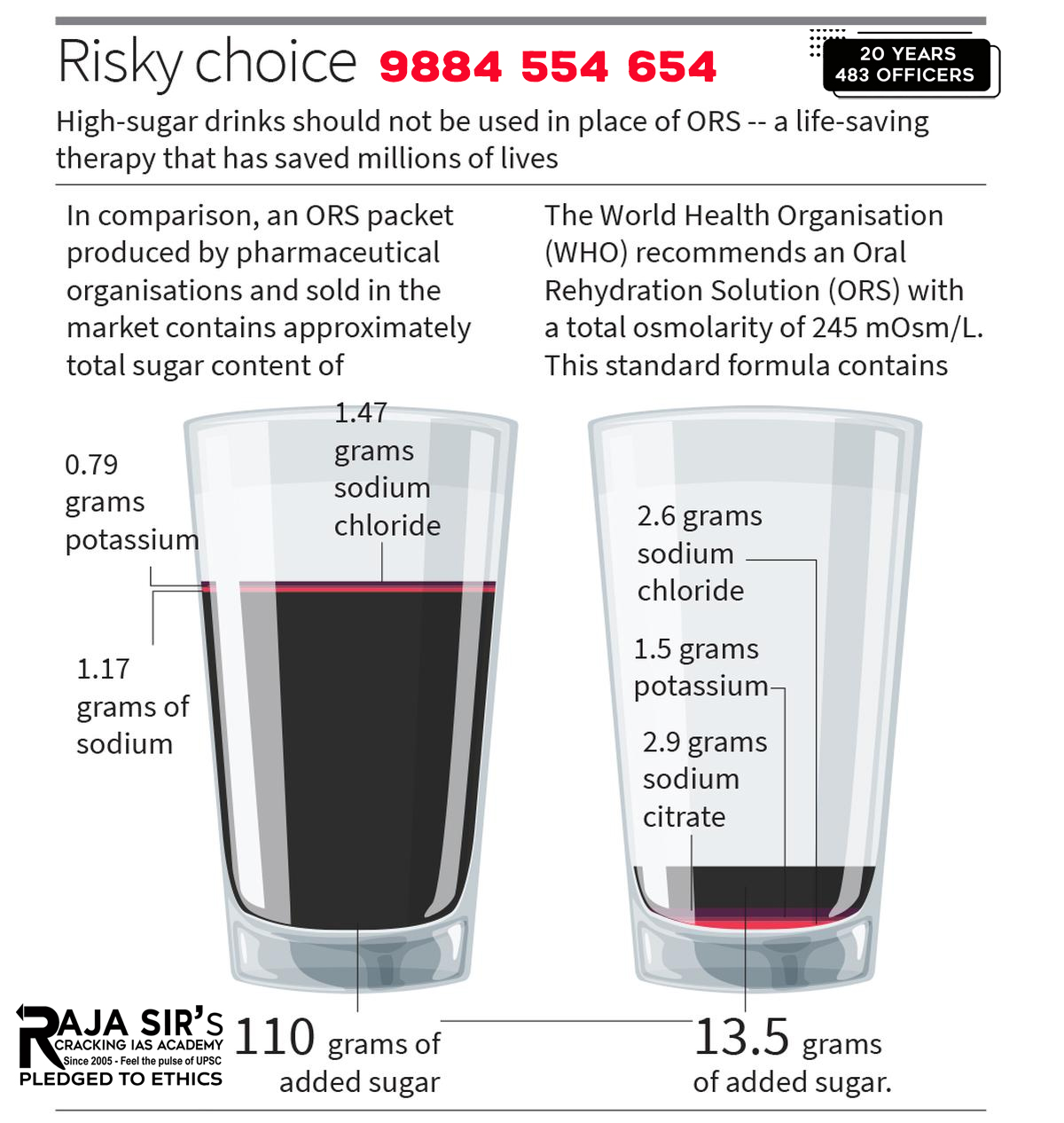
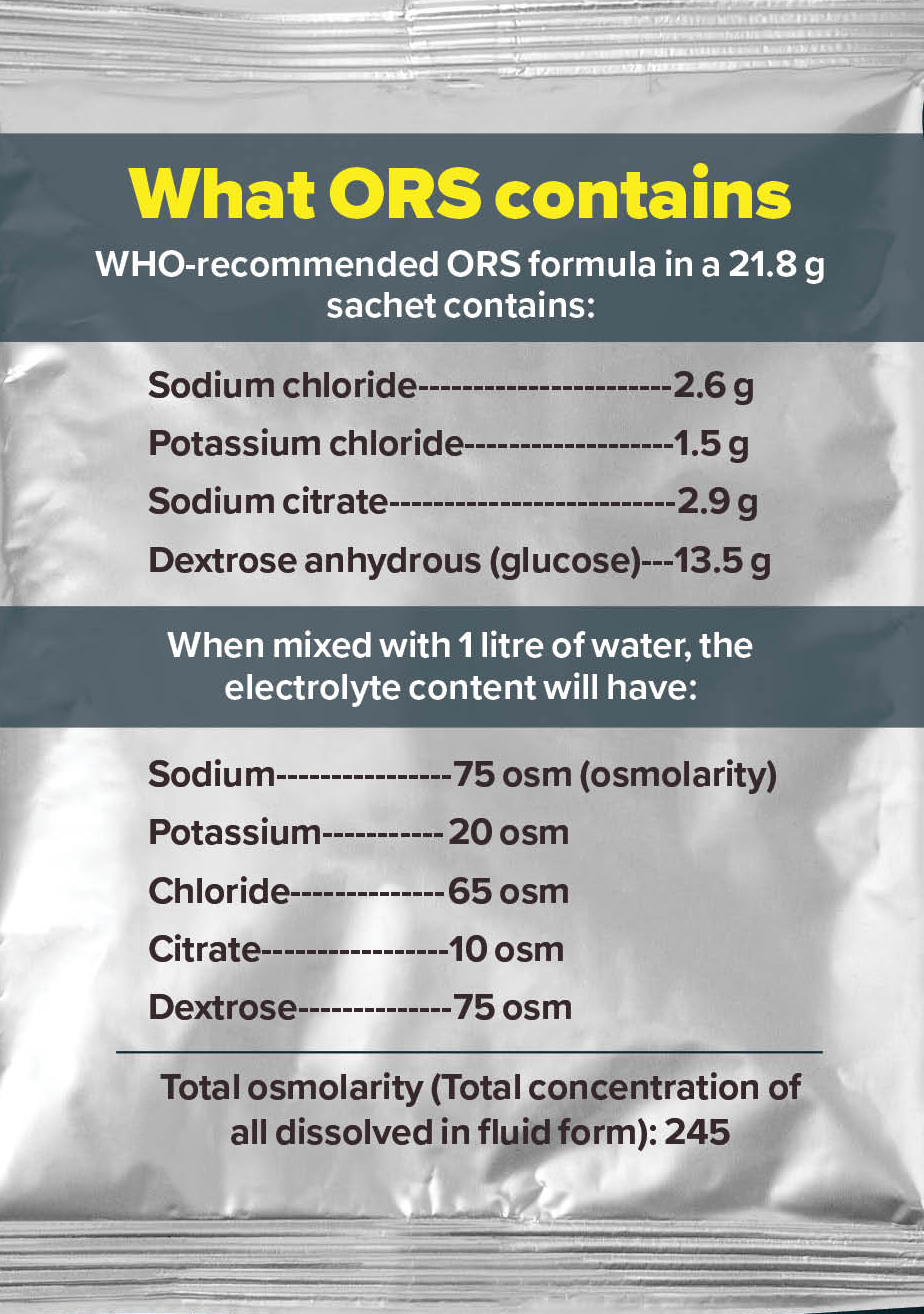
- Authentic ORS, as per WHO standards, must contain precise amounts of glucose anhydrous (13.5 g), sodium chloride (2.6 g), potassium chloride (1.5 g), and trisodium citrate (2.9 g) per liter.
- Fake ORS products on the market often replaced glucose with cheaper sugars, added artificial flavors and colors, and lacked the balanced electrolytes essential for safe rehydration—posing health risks, especially for sick children or dehydrated patients.
How does oral rehydration solution work?
ORS typically contains a precise mix of:
- Glucose (sugar)
- Sodium and potassium salts
- Citrate or bicarbonate (a base)
- Clean water
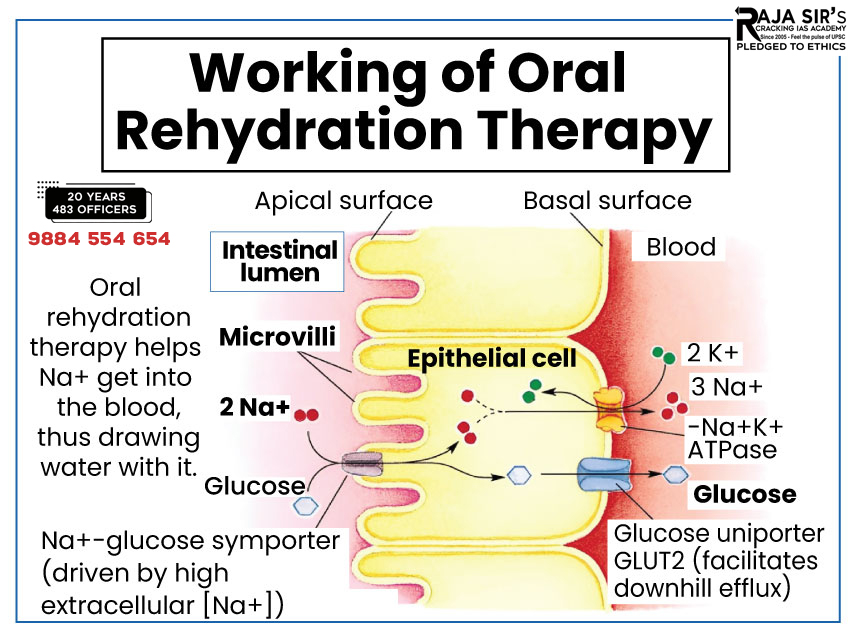
- Sodium-Glucose Co-Transport: The magic lies in how sodium and glucose work together. In the small intestine, glucose helps sodium get absorbed into the bloodstream through a co-transport mechanism. Water follows this absorption due to osmosis, rapidly rehydrating the body.
- Electrolyte Replenishment: Sodium and potassium are essential electrolytes lost during dehydration. ORS restores their balance, helping maintain nerve function, muscle contractions, and fluid balance.
- Acid-Base Balance: Some ORS formulations include a base (like citrate) to counteract acidosis, a condition where the body becomes too acidic due to severe diarrhea.
- ORS is absorbed even when vomiting or diarrhea is ongoing.
- It’s simple, inexpensive, and can be administered without medical supervision.
- It prevents and treats dehydration effectively, reducing the need for intravenous fluids in many cases.
Campaign and Legal Action
- This regulatory action marks the culmination of an eight-year public campaign led by Hyderabad-based pediatrician Dr. Sivaranjani Santosh, who exposed how sugary drinks branded as “ORS” worsened dehydration in children suffering from diarrhea. Her efforts were supported by the Endocrine Society of India, and a related case is pending before the Telangana High Court to curb deceptive health marketing practices.
Enforcement Measures
- FSSAI has directed all state and UT food safety commissioners to immediately remove “ORS” tags from food or drink products and enforce stringent penalties for violations under Sections 52 and 53 of the Food Safety and Standards Act, 2006.
- Only pharmaceutical-grade ORS solutions meeting WHO’s therapeutic formula can continue to use the label “ORS” in India.
Significance of the Ban
- This ban aims to protect public health and restore consumer trust by ensuring that “ORS” — a life-saving medical product for dehydration — is no longer misused as a marketing gimmick by beverage companies.
- Health experts have called it a landmark step toward curbing deceptive advertising and safeguarding vulnerable populations such as children and diabetics from misleading products.
Ethical theories Applied
Producing fake ORS products can be ethically analyzed through several moral theories that explain the motivations and wrongness of such conduct. The most relevant ones are ethical egoism, utilitarianism, and deontological ethics.
Ethical Egoism
Ethical egoism holds that an action is morally right if it serves one’s self-interest. Companies manufacturing fake ORS often prioritize profit motives over consumer safety—an outcome consistent with egoistic thinking. In this view, the unethical producers act from greed, choosing actions that benefit their market share or brand reputation at the expense of public health. Although egoism can drive innovation in capitalism, unrestrained self-interest becomes morally corrupt when it endangers lives and misleads consumers.
Utilitarian Perspective
From a utilitarian framework (Bentham and Mill), producing fake ORS is unethical because its consequences lead to greater harm than good. The fake products—high in sugar and lacking proper electrolytes—worsen dehydration and health outcomes, particularly in children suffering from diarrhea. Thus, the overall suffering and potential fatalities far outweigh the profit or pleasure of a few manufacturers.
Deontological Ethics
Deontological (Kantian) ethics emphasizes moral duty and truthfulness. Producing fake ORS violates the categorical imperative by treating consumers merely as means to profit rather than as ends deserving honesty and safety. Mislabeling energy drinks or hiding warnings in unreadable disclaimers directly contradicts a business’s moral duty to be transparent and respect human dignity.
Meta-ethical Reflection
From a meta-ethical lens, such wrongdoing can also be framed through moral realism, which assumes objective moral facts—such as that deceiving consumers and risking children’s lives is inherently wrong. Under this view, fake ORS production is unethical regardless of context because it violates universal moral truths about honesty and harm.
The act of producing fake ORS is hence best explained by ethical egoism as the driving force behind the behavior, but condemned by utilitarianism and deontology for its harmful consequences and moral deceit. India’s decisive action against fake ORS products is a landmark example of ethical governance balancing commercial interests with societal welfare. It ensures that “ORS” remains a trusted life-saving solution, thereby safeguarding health, restoring public trust, and enforcing justice for the most vulnerable.