




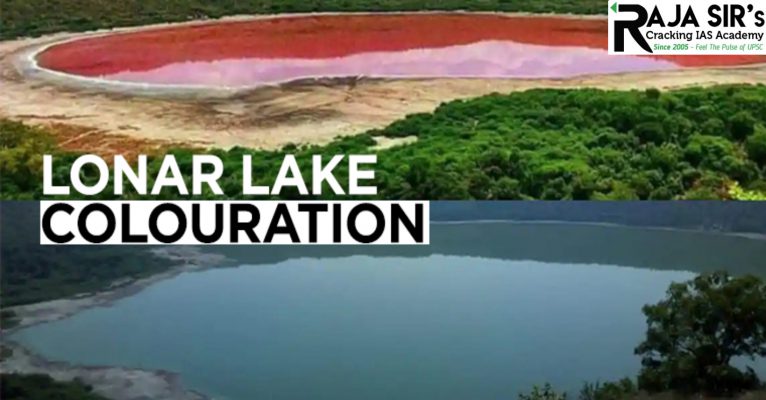
 According to the Agharkar Research Institute, the colour of Lonar lake water in Maharashtra’s Buldhana district turned pinkdue to a large presence of the salt-loving ‘Haloarchaea’ microbes.
- The colour of the lake water recently turned pink, which not only surprised locals, but also nature enthusiasts and scientists.
- The water samples have been tested by the Nagpur-based National Environmental Engineering Research Institute (NEERI) and the Agharkar Research Institute in Pune.
- It has been assumed that the absence of rain, less human interference (owing to lockdown) and high temperatureresulted in the evaporation of water which increased its salinity and pH.
- pH is a measure of how acidic/basic water is.
- The increased salinity and pH facilitated the growth of halophilic microbes, mainly Haloarchaea.
- Halophiles are a group of microorganisms that can grow and often thrive in areas of high salt (NaCl) concentration.
- Haloarchaea or halophilic archaea is a bacteria culture which produces pink pigment and is found in water saturated with salt.
- Because of the biomass of Haloarchaea microbes, the surface of the water turned red or pink. As the biomass subsides, the colour will disappear.
- The colour of the lake is now returning to original as the rainy season has kicked in, allowing dilution of the water. The salinity and pH/alkalinity levels have also come down and green algae have started growing in the water body.
- Further, it was noted that Haloarchaea microbes were ingested by Flamingos.
- These microbes acted as carotenoid (pigment) rich food for the birds.
- Flamingos get their red-pink colour from special colouring chemicals called pigments found in the algae and invertebrates they eat.
Lonar Lake
- Lonar Lake, also known as Lonar crater, is a saline and alkaline lake located at Lonar in Buldhana district,Maharashtra.
- It is situated inside the Deccan Plateau—a massive plain of volcanic basalt rock created by eruptions.
- It is an oval shaped and has a mean diameter of 1.2 km. It is a popular tourist hub.
- It is a notified National Geo-heritage Monument.
- Geo-heritage refers to the geological features which are inherently or culturally significant offering insight to earth’s evolution or history to earth science or that can be utilized for education.
- Geological Survey of India (GSI) is the parent body which is making efforts towards identification and protection of geo-heritage sites.
- It is believed to have been created over 52,000 years ago when a meteorite hit the Earth.