India, China face-off along Sikkim border, several
soldiers injured
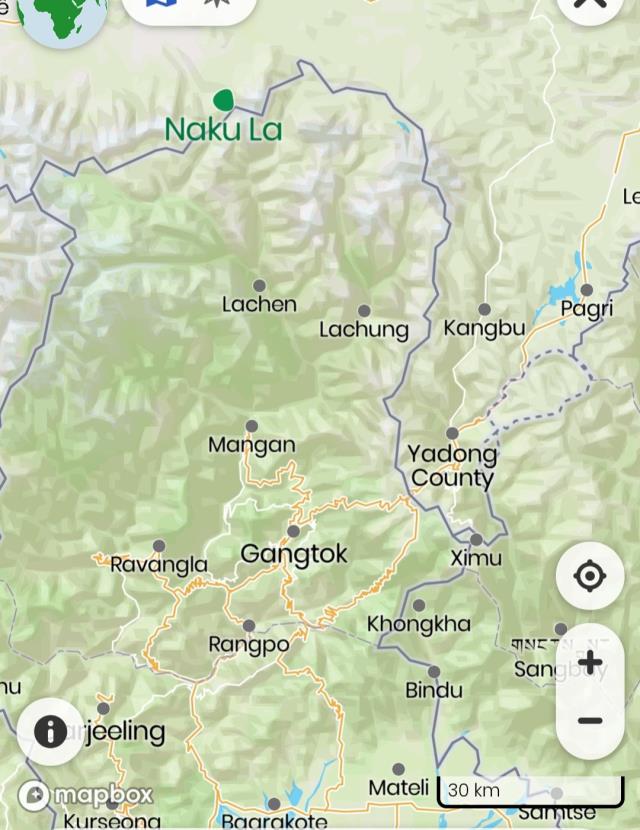
Recently, Indian and Chinese troops engaged in a temporary and short duration face-off along the Line of Actual Control (LAC) at Naku La (Sikkim) and near Pangong Tso Lake (Eastern Ladakh).
Naku La
Naku La sector is a pass
at a height of more than 5,000 metres above Mean Sea Level (MSL) in the state
of Sikkim.
It is located ahead of
Muguthang or Cho Lhamu (source of River Teesta).
At Muguthang, the road
on the Chinese side is motorable, and on the Indian side, it is a remote area.
The other passes located
in the state of Sikkim are Nathu La Pass and Jelep La Pass.
Pangong Tso Lake
Pangong Lake is located
in the Union Territory of Ladakh.
It is situated at a
height of almost 4,350m and is the world’s highest saltwater lake.
Extending to almost
160km, one-third of the Pangong Lake lies in India and
the other two-thirds in China.
The temporary and brief
face-offs occur because the unresolved and undemarcated boundary
issues.
The India-China
border shares the 3,488-km-long Line of Actual Control.
Both countries have
differing perceptions owing to the undemarcated boundary, which
lead to transgressions and face-offs as each side patrols up to the areas.
Any such issue is
resolved through the mutually established protocols to
maintain peace and tranquillity on the border. The resolving mechanism also
involves the local Border Personnel Meeting (BPM).
These protocols with
China have been established to resolve issues amicably at the local formation
commander level.
The recent clash
happened three years after the Doklam stand-off between India and China
(2017), which was also experienced across the border in Sikkim.
Doklam, or Donglang in
Chinese, is an area spread over less than a 100 sq km comprising
a plateau and a valley at the trijunction between India,
Bhutan and China.
The Doklam issue was
discussed in the Wuhan Summit (2018) and two nations decided
to issue "strategic guidance" to their
militaries to strengthen communications so that they can build
trust and understanding.
McMahon Line
Line of Actual Control
The 890-km McMahon Line
separating British India and Tibet was drawn by Sir Henry
McMahon at the China-Tibet-Britain Simla Convention (1914).
The Line of Actual Control (LAC) is the effective
border between India and China.
The line marked out previously
unclaimed/undefined borders between Britain and Tibet. Also the Line put
Tawang (a region of the present Arunachal Pradesh) in the British empire.
LAC was supposed to divide areas under Indian
and Chinese control since the end of the Sino-Indian War of
1962.
The line was forgotten until the British government
published the documents in 1937. Subsequently, China
refused to accept the line.
Unlike the LoC (between India and Pakistan), the LAC
was not mutually agreed upon. This was because the war ended
with a unilateral ceasefire by China.
Aggressive Diplomacy by China
Covid-19 Origin:
China has been engaged
in aggressive diplomacy with western countries, which have
sought clarity on the origins of the Covid-19 pandemic that
has crippled the world economy, and led to almost four million people across
the globe falling ill.
South China Sea:
It has also reported
that China has established new administrative districts for the Spratly
and Paracel archipelagos in the South China Sea.
China has also named 80
islands and other geographical features in the sea, claiming sovereignty over
underwater features in the contested region.
India launches Mission Sagar to assist island nations in
Eastern Indian Ocean
India has sent Indian Naval Ship (INS) Kesari, carrying
food items and medical assistance teams, to countries in the southern Indian
Ocean to deal with Covid-19 pandemic as part of a "Mission
Sagar" initiative.
The countries
including Maldives, Mauritius, Madagascar, Comoros and Seychelles had
requested India for assistance in dealing with the Covid-19 pandemic.
Mauritius, Madagascar,
Comoros and Seychelles along with La Réunion are part
of Indian Ocean Commission. India has recently become an
observer to the Commission.
This is the first
time that a single assistance mission is covering all island countries of the
western Indian Ocean in one go — except Sri Lanka, for
which a second set of medicines have been airlifted.
The assistance is
in line with India’s role as the first responder in the Indian Ocean region.
It highlights the
importance accorded by India to relations with her neighbouring countries and
further strengthens the existing bond.
The deployment is also
in consonance with the Prime Minister's vision of Security and Growth
for All in the Region (SAGAR).
Under the Mission, India
will
Deploy Medical
Assistance Teams in Mauritius and Comoros, helping their Governments
deal with Covid emergency and in case of Comoros, with dengue fever also.
Deliver consignments
of Covid related essential medicines to Mauritius, Madagascar, Comoros
and Seychelles and about 600 tonnes of food items to Maldives.
In addition, in case of Mauritius, a special
consignment of Ayurvedic medicines is also being sent.
The consignments also
include Hydroxychloroquine tablets.
SAGAR
Security and Growth for
All in the Region (SAGAR) was launched in 2015. It is India’s strategic
vision for the Indian Ocean Region (IOR).
Through SAGAR, India
seeks to deepen economic and security cooperation with its
maritime neighbours and assist in building their maritime security
capabilities.
Further, India seeks to
safeguard its national interests and ensure Indian Ocean
region to become inclusive, collaborative and respect international
law.
The key relevance of
SAGAR emerges when seen in conjunction with India’s other policies impacting
the maritime domain like Act East Policy, Project Sagarmala, Project
Mausam, India as ‘net security provider’, focus onBlue
Economy etc.
Tata Sons to Scale-up Covid-19 Testing Kit 'Feluda'
Recently, the Council of Scientific and
Industrial Research’s Institute of Genomics and Integrative Biology
(CSIR-IGIB) has developed India’s first paper strip test for Covid-19 namely, ‘Feluda’.
Description:
The Feluda is a paper
strip test that detects the coronavirus in an hour.
Feluda is an acronym for FNCAS9
Editor Linked Uniform Detection.
It is expected to help
to fulfil an urgent need of the rapid testing in India.
It is the first such
indigenous test kit to be developed in India based on Clustered
Regularly Interspaced Short Palindromic Repeats (CRISPR) technology.
CRISPR is a gene editing
technology, which replicates natural defence mechanisms in bacteria to
fight virus attacks, using a special protein called Cas9.
CRISPR-Cas9 technology behaves like a
cut-and-paste mechanism on DNA strands that contain genetic
information. The specific location of the genetic codes that need to be
changed, or edited, is identified on the DNA strand, and then, using the Cas9
protein, which acts like a pair of scissors, that location is cut off from the
strand.
A DNA strand, when broken, has a natural tendency to
repair itself. Scientists intervene during this auto-repair process, supplying
the desired sequence of genetic codes that binds itself with the broken DNA
strand.
Comparison to the RT-PCR
Test:
Working Principle: The Feluda test
uses the gene-editing tool-Crispr-Cas9 to target and identify
genomic sequences of the novel coronavirus in suspected individual samples.
RT-PCR test (Reverse Transcription Polymerase Chain
Reaction) detects the virus genetic material, which is the
Ribonucleic acid (RNA) .
Cost: The Feluda test
will cost less than Rs.500 compared to Rs. 4500 for the real-time PCR test
which is currently being used for Covid-19 diagnosis in India.
Required Medical
Machinery: The Feluda test also does not rely on
expensive real-time PCR machines for RNA isolation, DNA conversion,
and amplification which are already in limited supply in the country.
480th Birth Anniversary of Maharana Pratap:
Narendra Modi, Venkaiah Naidu remember Rajput king who fought Mughals valiantly
Recently, the Prime Minister and Vice President of India
paid tributes to Maharana Pratap on his 480th birth
anniversary.
Rana Pratap Singh also
known as Maharana Pratap was born on May 9th 1540 in
Kumbhalgarh, Rajasthan.
He was the 13th King
of Mewar and was the eldest son of Udai Singh
II
Maharana Udai Singh II ruled the kingdom of
Mewar, with his capital at Chittor.
Udai Singh II was also a founder of the city of
Udaipur (Rajasthan).
Battle of Haldighati
The Battle of
Haldighati was fought in 1576 between Rana
Pratap Singh of Mewar and Raja Man Singh of Amber who was the general
of the Mughal emperor Akbar.
Maharana Pratap fought a
brave war, but was defeated by Mughal forces.
It is said that Maharana
Pratap’s loyal horse named Chetak, gave up his life as the
Maharana was leaving the battlefield.
Reconquest
After 1579, the Mughal
pressure relaxed over Mewar and Pratap recovered Western Mewar including
Kumbhalgarh, Udaipur and Gogunda.
During this period, he
also built a new capital, Chavand, near modern Dungarpur.
DRDO lab develops automated UV systems to sanitise
electronic gadgets, papers etc
Recently, the Research Centre Imarat (RCI),
has developed an automated contactless UVC (short-wavelength
ultraviolet light with wavelengths between 200-280 nanometers) sanitisation
cabinet, called Defence Research UltraViolet Sanitiser (DRUVS)
and an automated UVC currency sanitising device, called NOTESCLEAN.
RCI is a Hyderabad based Defence
Research and Development Organisation (DRDO) premier lab.
Earlier, DRDO had
developed UV Blaster(ultraviolet disinfection tower) for
rapid and chemical free disinfection of high infection prone areas.
Defence Research Ultraviolet Sanitiser
It has been designed to
sanitise mobile phones, iPads, laptops, currency notes, cheque leafs,
challans, passbooks, paper, envelopes, etc.
The DRUVS cabinet has
a contactless operation which becomes crucial to contain the
spread of Covid-19 and other viruses.
It has proximity
sensor switches, clubbed with drawer opening and closing mechanism
which makes its operation automatic and contactless.
It provides 360
degree exposure of UVC to the objects placed inside the cabinet and
it automatically goes into sleep mode after the sanitation
process.
The device picks the
note inserted from the input slot and makes them pass through a series
of UVC lamps for complete disinfection.
It will save a
lot of time because disinfection of each currency note by DRUVS or any
other sanitising process is a time consuming process.
Defence Research and Development
Organisation
It works under the administrative
control of the Ministry of Defence.
Objective: To establish a
world class science and technology base for India and provide Indian Defence
Services decisive edge by equipping them with internationally competitive
systems and solutions.
It was established in 1958 after combining
Technical Development Establishment (TDEs) of the Indian Army and the Directorate
of Technical Development & Production (DTDP) with the Defence
Science Organisation (DSO).
National Technology Day
India is observing its 29th National
Technology Day on 11th May, 2020.
The day which was first
observed on 11 May, 1999, aims to commemorate the scientific and
technological achievements of Indian scientists, engineers. The day was named
by the former Prime Minister Atal Bihari Vajpayee.
Every year, the Technology
Development Board of India (a statutory body under the Ministry of
Science and Technology) celebrates the day by awarding individuals with
National Award for their contribution to science and technology in India.
The focus this year
is ‘Rebooting the economy through Science and Technology.’
Significance
It is the day India
successfully tested nuclear bombs in Pokhran on May 11, 1998.
India successfully
test-fired its Shakti-1 nuclear missile in operation called Pokhran-II, also
codenamed as Operation Shakti.
The nuclear missile was
tested at the Indian Army's Pokhran Test Range in Rajasthan. This was the
second test which was conducted after Pokhran-I codenamed Operation
Smiling Buddha, in May 1974.
On the same day, India
performed a successful test firing of the Trishul Missile (surface
to air short range missile) and had test flown the first indigenous aircraft
– ‘Hansa – 3’.




 Latest News