



Why Solar Storms Occur?. What are its effects?.
Why Solar Storms Occur?. What are its effects?.
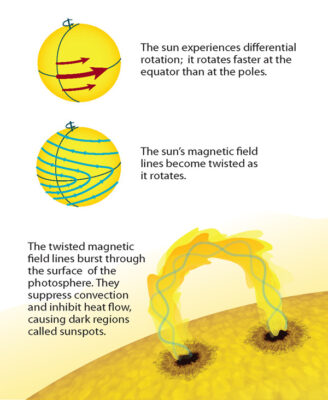
Solar storms are magnetic plasma ejected at great speed from the solar surface. They usually occur during the release of magnetic energy associated with sunspots. They can last for few minutes or hours depending on the intensity.
 Reasons for occurrence
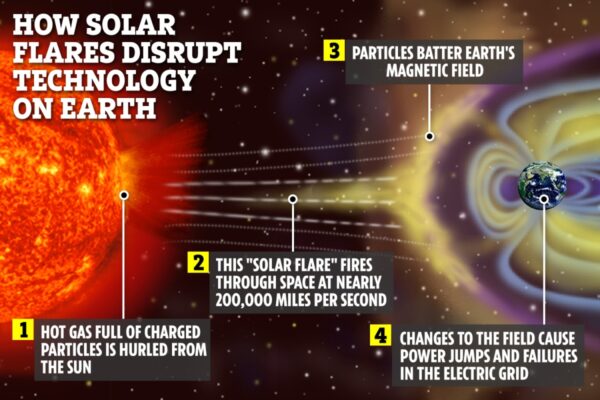 Thus, solar storms are not just a phenomenon of the Sun. The particles emitted during solar storms have long-lasting effects on earth and its atmosphere.
Reasons for occurrence
- High magnetism Due to high magnetic activity in the interior of the Sun, particular areas do not experience high temperatures. This forms sunspots that emit solar particles.
- Ejection of coronal mass Coronal mass or solar particles are closely associated with sun spots. Darker the sunspots, greater amount of coronal particles are ejected.
- Impact weather High-speed solar winds and coronal mass ejections (CMEs) can come near to Earth’s atmosphere and impact weather events.
- Global communication They can impact space-dependent services like global positioning systems (GPS), radio, and satellite communications.
- Technologies Technologies such as high-frequency radio communications and GPS navigation systems. Power grids, aircraft flights, and space exploration programmes are vulnerable.
- Space programme Coronal Mass Ejections can create disturbances for satellites. Astronauts on spacewalks face health risks from possible exposure to solar radiation.
Thus, solar storms are not just a phenomenon of the Sun. The particles emitted during solar storms have long-lasting effects on earth and its atmosphere.
Posted on 05-02-2022 • By Admin