



20 suspected new marine species arise from Schmidt Ocean Institute’s Nazca Ridge expedition
20 suspected new marine species arise from Schmidt Ocean Institute’s Nazca Ridge expedition
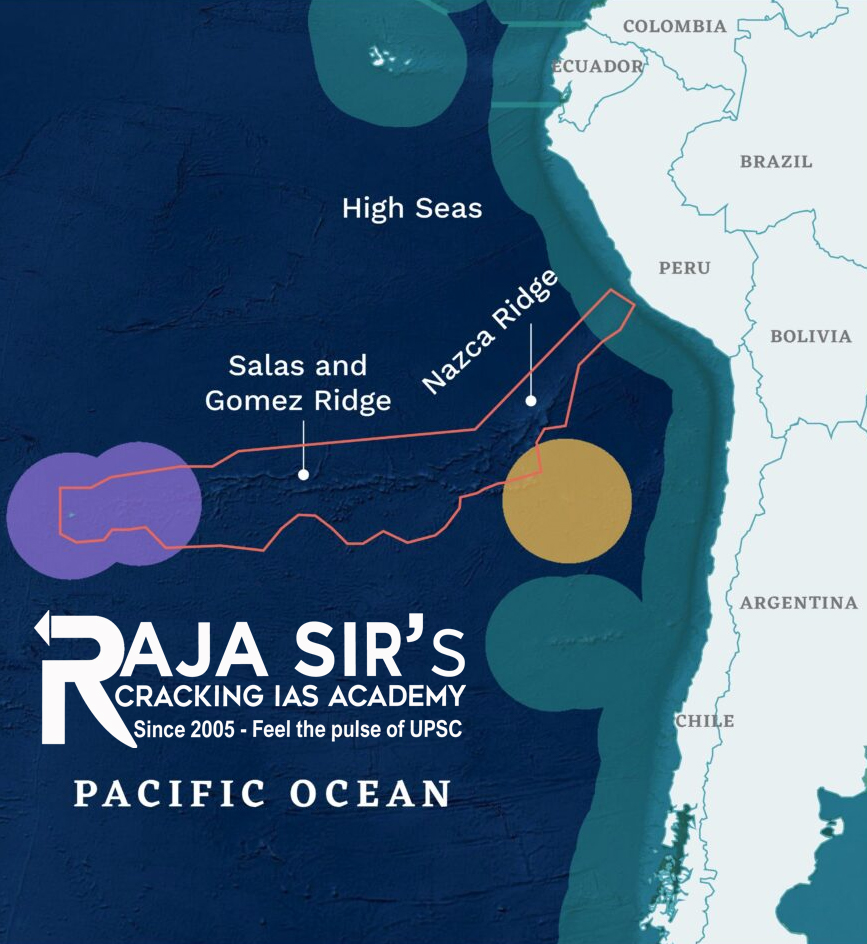
Recently, a team of oceanographers identified and charted a new seamount on the Nazca Ridge, located 900 miles off the coast of Chile in international waters.
Nazca Ridge
- Location:The Nazca Ridge is a prominent submarine geological feature located in the southeastern Pacific Ocean.
- Area:It extends over 1,100 kilometers (about 680 miles) from the coast of Peru towards the west.
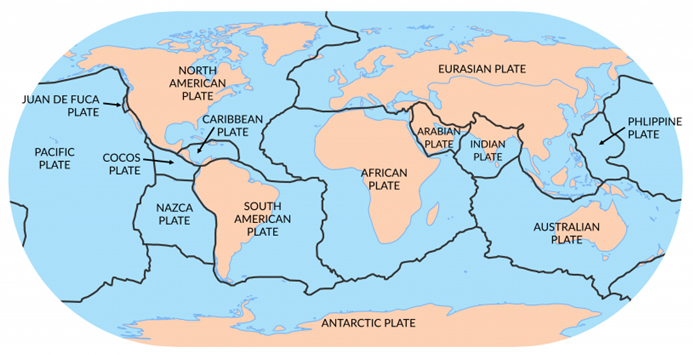
- Geology:The ridge is part of the Nazca Plate, which is an oceanic tectonic plate that underlies much of the southeastern Pacific Ocean.
- Formation:The Nazca Ridge formed over a hotspot, where rising magma created volcanic islands and underwater mountains made mostly of basalt.
- Geologically, the Nazca Ridge is notable for its interaction with the South American Plate. As the Nazca Plate moves eastward, it subducts beneath the South American Plate along the Peru-Chile Trench.
- This subduction influences regional earthquakes, volcanic activity, and the uplift of the Andes. The ridge’s presence also affects the subduction angle, leading to unique geological phenomena.
- The unique underwater topography of the ridge creates a range of habitats for marine life, supporting diverse ecosystems. It is home to a variety of marine species, including many that are unique to the area.
Seamount
- A seamount is an underwater mountain with steep sides rising from the seafloor.
- Most seamounts are remnants of extinct volcanoes.
- Typically, they are cone-shaped but often have other prominent features such as craters and linear ridges, and some, called guyots, have large, flat summits.
- There is a broad size distribution for seamounts, but to be classified as a seamount, the feature must have a vertical relief of at least 1,000 meters (3,300 feet) above the surrounding seafloor.
- Seamounts are found in every world ocean basin.
- These are formed near mid-ocean ridges, where the earth’s tectonic plates are moving apart, allowing molten rock to rise to the seafloor.
- Some seamounts have also been found near intraplate hotspots – regions of heavy volcanic activity within a plate – and oceanic island chains with a volcanic and seismic activity called island arcs.
- The Salas y Gomez and Nazca Ridges, two adjacent seamount chains in the Southeast Pacific, are biodiversity hotspots marked by the highest levels of marine endemism on Earth.
Nazca plate
- It is located in the eastern Pacific Ocean, near the western coast of South America. It interacts with the South American Plate.
- Its collision with the South American Plate contributes to the creation of the Andes Mountains. This interaction also leads to significant volcanic activity in the region.
- The Nazca Plate is being pushed under the South American Plate in a process called subduction. This subduction affects the region’s geology, including earthquakes and volcanic eruptions.
Posted on 19-09-2024 • By Admin