



Solar flares and geo magnetic storms
Solar flares and magnetic storms belong to a set of phenomena known collectively as "space weather". Technological systems and the activities of modern civilization can be affected by changing space-weather conditions. However, it has never been demonstrated that there is a causal relationship between space weather and earthquakes. Indeed, over the course of the Sun''s 11-year variable cycle, the occurrence of flares and magnetic storms waxes and wanes, but earthquakes occur without any such 11-year variability. Since earthquakes are driven by processes in the Earth''s interior, they would occur even if solar flares and magnetic storms were to somehow cease occurring.
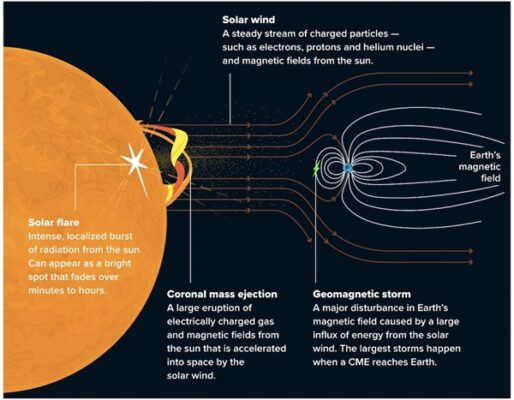
Geomagnetic Storms
-
Solar Storms occur during the release of magnetic energy associated with sunspots (‘dark’ regions on the Sun that are cooler than the surrounding photosphere - the lowest layer of the solar atmosphere), and can last for a few minutes or hours.
-
A geomagnetic storm is a major disturbance of Earth''s magnetosphere that occurs when there is a very efficient exchange of energy from the solar wind into the space environment surrounding Earth.
-
The magnetosphere shields our home planet from harmful solar and cosmic particle radiation, as well as erosion of the atmosphere by the solar wind – the constant flow of charged particles streaming off the Sun.
-
-
These storms result from variations in the solar wind that produce major changes in the currents, plasmas, and fields in Earth’s magnetosphere.
-
The solar wind conditions that are effective for creating geomagnetic storms are sustained (for several to many hours) periods of high-speed solar wind, and most importantly, a southward directed solar wind magnetic field (opposite the direction of Earth’s field) at the dayside of the magnetosphere.
-
This condition is effective for transferring energy from the solar wind into Earth’s magnetosphere.
-
-
The largest storms that result from these conditions are associated with solar Coronal Mass Ejections (CMEs) where a billion tons or so of plasma from the sun, with its embedded magnetic field, arrives at Earth.
-
CMEs are large ejections of plasma and magnetic fields that originate from the Sun''s corona (outermost layer).
-
Impact
-
Can Impact Space Weather:
-
Not all solar flares reach Earth, but solar flares/storms, Solar Energetic Particles (SEPs), high-speed solar winds, and Coronal Mass Ejections (CMEs) that come close can impact space weather in near-Earth space and the upper atmosphere.
-
-
Can Hit Operations of Space-Dependent Services:
-
Solar storms can hit operations of space-dependent services like Global Positioning Systems (GPS), radio, and satellite communications. Aircraft flights, power grids, and space exploration programmes are vulnerable.
-
-
Can Potentially Create Disturbances in the Magnetosphere:
-
Coronal Mass Ejections (CMEs) with ejectiles loaded with matter travelling at millions of miles an hour, can potentially create disturbances in the magnetosphere, the protective shield surrounding the Earth.
-
Astronauts on spacewalks face health risks from possible exposure to solar radiation outside the Earth’s protective atmosphere.
-
Prediction of Solar Storms
-
Solar physicists and other scientists use computer models to predict solar storms and solar activities in general.
-
Current models are capable of predicting a storm’s time of arrival and its speed.
-
But the storm’s structure or orientation still cannot be predicted.
-
-
Certain orientations of the magnetic field can produce a more intense response from the magnetosphere, and trigger more intense magnetic storms.
-
With the increasing global dependence on satellites for almost every activity, there is a need for better space weather forecasts and more effective ways to protect satellites.
-