



There is nothing called Ethical Surrogacy
Surrogacy (Regulation) Act, 2021
- Provisions:
- Under the Surrogacy (Regulation) Act, 2021, a woman who is a widow or a divorcee between the age of 35 to 45 years or a couple,defined as a legally married woman and man, can avail of surrogacy if they have a medical condition necessitating this option.
- It alsobans commercial surrogacy, which is punishable with a jail term of 10 years and a fine of up to Rs 10 lakhs.
- The law allows only altruistic surrogacywhere no money exchanges hands and where a surrogate mother is genetically related to those seeking a child.
- Challenges:
- Exploitation of the Surrogate and the Child:
- One could argue that the state must stop the exploitation of poor women under surrogacy and protect the child’s right to be born. However, the current Act fails to balance these two interests.
- Reinforces Patriarchal Norms:
- The Act reinforces traditional patriarchal norms of our society that attributes no economic value to women’s workand, directly affecting the fundamental rights of the women to reproduce under Article 21 of the constitution.
- Denies Legitimate income to Surrogates:
- Banning commercial surrogacy also denies a legitimate source of income of the surrogates,further limiting the number of women willingly to surrogate.
- Overall, this step indirectly denies children to the couples choosing to embrace parenthood.
- Emotional Complications:
- In altruistic surrogacy, a friend or relative as a surrogate mother may lead to emotional complications not only for the intending parents but also for the surrogate child as there is great deal of risking the relationship in the course of surrogacy periodand post birth.
- Altruistic surrogacy alsolimits the option of the intending couple in choosing a surrogate mother as very limited relatives will be ready to undergo the process.
- No Third-Party Involvement:
- In an altruistic surrogacy, there is no third-party involvement.
- A third-party involvement ensures that the intended couple will bear and support the medical and other miscellaneous expensesduring the surrogacy process.
- Overall, a third party helps both the intended couple and the surrogate mother navigate through the complex process, which may not be possible in the case of altruistic surrogacy.
- Exploitation of the Surrogate and the Child:
Surrogacy
- Surrogacy is an arrangement in which a woman (the surrogate) agrees to carry and give birth to a child on behalf of another person or couple (the intended parent/s).
- A surrogate, sometimes also called a gestational carrier, is a woman who conceives, carries and gives birth to a child for another person or couple (intended parent/s).
- Altruistic surrogacy:
- It involves no monetary compensation to the surrogate mother other than the medical expenses and insurance coverage during the pregnancy.
- Commercial surrogacy:
- It includes surrogacy or its related procedures undertaken for a monetary benefit or reward (in cash or kind) exceeding the basic medical expenses and insurance coverage.
Assisted Reproductive Technology
- ART is used to treat infertility. It includes fertility treatments that handle both a woman''s egg and a man''s sperm.It works by removing eggs from a woman''s body and mixing them with sperm to make embryos. The embryos are then put back in the woman''s body.
- In Vitro fertilization(IVF) is the most common and effective type of ART.
- ART proceduressometimes use donor eggs, donor sperm, or previously frozen embryos. It may also involve a surrogate carrier.
|
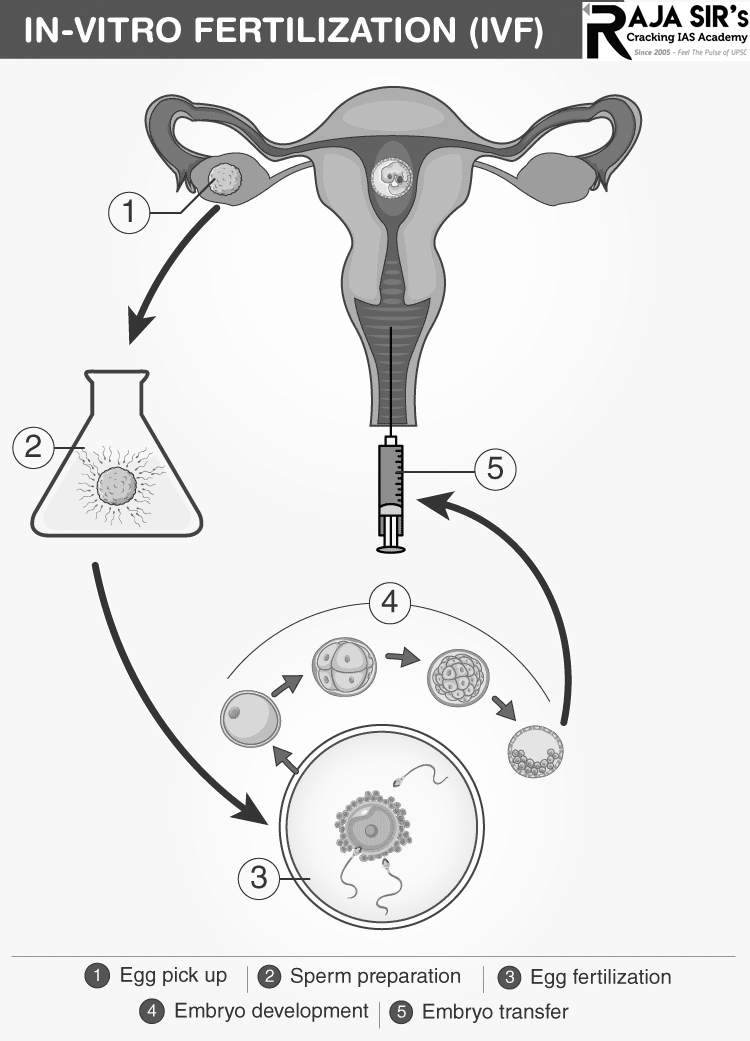
In-Vitro Fertilisation In-vitro fertilisation (IVF) is an assisted reproductive technology (ART) where an egg and a sperm are fertilised outside a woman’s body in a laboratory. It is a process that is used to overcome infertility and support surrogacy. It was first successfully performed in 1978, when IVF gave birth to Louis Brown. Lesley Brown, his mother, had been facing infertility issues since 9 years when she took help from Patrick Steptoe and Robert Edwards at Dr Kershaw’s Cottage Hospital in Royton, Oldham, England. |
|
After the release of sperm into the female reproductive tract, these sperms being motile swim through the vagina to the cervix to the uterus and further up to the fallopian tube. The fallopian tube is made of three regions:-
The egg is collected by the fimbriae of the infundibulum and pushed by ciliated columnar epithelial cells to the ampullary region where sperm fertilize the egg. |
Procedure
The five steps of in-vitro fertilisation are as follows:
- Stimulation / Superovulation
Normally, a woman produces one egg per month. But for IVF procedures, doctors give drugs to women to produce several eggs in a month. These eggs are examined from time to time to pick the healthiest one in the next step.
- Retrieval of Egg and Sperm Preparation
The eggs are retrieved from the female by a procedure known as transvaginal oocyte retrieval. An oocyte selection is performed to select the egg that has the highest chance of fertilisation. The sperms are extracted from semen by removing inactive cells and seminal fluid in a process called sperm washing.
- Egg Fertilisation
The female egg and male sperm are incubated together for fertilisation. The sperm generally enters the egg and insemination is carried out, but in cases where sperm motility is low, the sperm is directly injected into the egg.
- Embryo Development
The fertilised egg divides to form an embryo. The embryo divides by cleavage to form a blastocyst (after 5-6 days of incubation).
- Embryo Transfer
The embryo is transferred to the uterus after 5-6 days of active division. The number of embryos that are transferred depends on the age of women and any other health concerns if present. The embryos are transferred through a tube-like apparatus called a catheter which goes up through her cervix and vagina into the womb. The embryo then sticks to the uterine lining and results in pregnancy.
- Legal Provisions:
- The ART (Assisted Reproductive Technology Act) Regulation 2021 providesa system for the implementation of the law on surrogacy by setting up of the National Assisted Reproductive Technology and Surrogacy Board.
- The Act aims at the regulation and supervision of ART clinics and assisted reproductive technology banks, prevention of misuse, and safe and ethical practice of ART services.
Offences and Punishment
The following acts are recognized as offences under the law and attract the corresponding punishment:
- Undertaking or advertising commercial surrogacy Imprisonment extending to ten years and fine extending to Rupees ten lakhs
- Abandoning, disowning or exploiting the child born out of surrogacy - Imprisonment extending to ten years and fine extending to Rupees ten lakhs
- Exploiting the surrogate mother - Imprisonment extending to ten years and fine extending to Rupees ten lakhs
- Selling, importing or trading in human embryos or gametes for the purpose of surrogacy - Imprisonment extending to ten years and fine extending to Rupees ten lakhs
- Conducting sex selection - Imprisonment extending to ten years and fine extending to Rupees ten lakhs
Any medical practitioner who commits any offence under the Act shall be punished with imprisonment extending upto five years and fine extending upto Rupees ten lakhs. If a subsequent offence is reported by the same person, he shall be reported to the appropriate authority and the State Medical Council for the suspension of his registration for five years.
- Shortcomings:
- Exclusion of Unmarried and Hetrosexual Couples:
- The Act excludes unmarried men, divorced men, widowed men, unmarried yet cohabiting heterosexual couples, trans persons and homosexual couples (whether married or cohabiting) from availing ART services.
- This exclusion is relevant as the Surrogacy Act also excludes above said persons from taking recourse to surrogacy as a method of reproduction.
- Reduces the Reproductive Choices:
- The Act is also limited to those commissioning couples who are infertile - those who have been unable to conceive after one year of unprotected coitus. Thus, it is limited in its application and significantly reduces the reproductive choices of those excluded.
- Unregulated Prices:
- The prices of the services are not regulated; this can certainly be remedied with simple directives.
- Exclusion of Unmarried and Hetrosexual Couples:
Looking Ahead
As India is one of the major hubs of these practices, the Act is certainly a step in the right direction. There, however, needs to be a dynamic oversight to ensure that the law keeps up with rapidly evolving technology, demands of morality and societal changes.