



Tipu Sultan
-
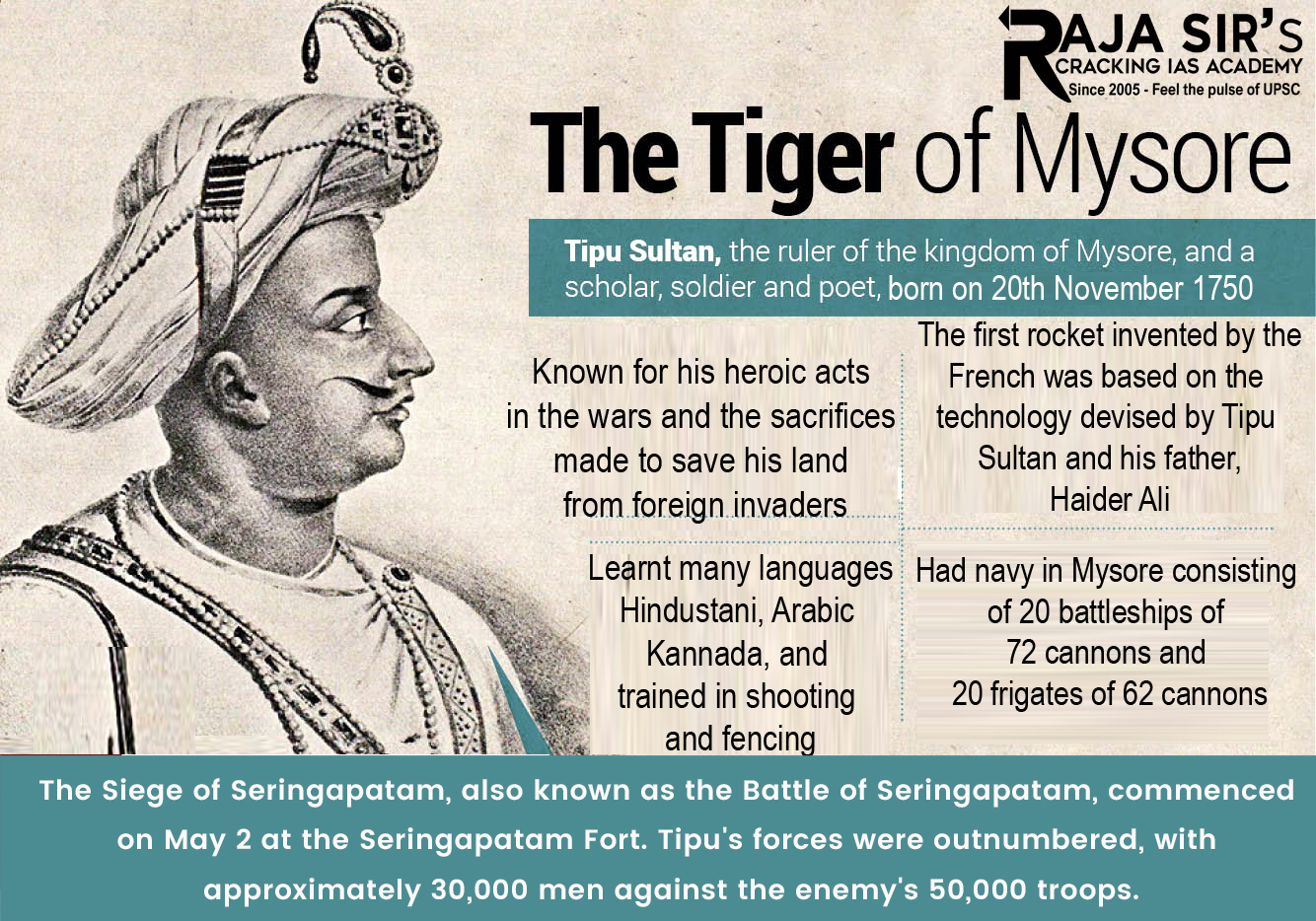
- Born in November 1750, Tipu Sultan was Haidar Ali’s son and a great warrior, also known as the Tiger of Mysore.
- He was a well educated man fluent in Arabic, Persian, Kanarese and Urdu.
- Mysore had grown in strength under the leadership of powerful rulers like Haidar Ali (ruled from 1761 to 1782) and his famous son Tipu Sultan (ruled from 1782 to 1799).
- Tipu introduced a number of administrative innovations during his rule, including his coinage, a new Mauludi lunisolar calendar, and a new land revenue system which initiated the growth of Mysore silk industry.
- Embracing western military methods like artillery and rockets alongside traditional Indian weapons including war elephants, he ensured his forces could overwhelm his Indian rivals and match the British armies sent against him.
- Maintenance of Armed Forces:
- He organised his army on the European model with Persian words of command.
- Though he took the help of the French officers to train his soldiers, he never allowed them (French) to develop into a pressure group.
- He was well aware of the importance of a naval force.
- In 1796, he set up a Board of Admiralty and planned for a fleet of 22 battleships and 20 large frigates.
- He established three dockyards at Mangalore, Wajedabad and Molidabad. However, his plans did not fructify.
- He organised his army on the European model with Persian words of command.
|
- Fought Against Marathas:
- In 1767, Tipu commanded a corps of cavalry against the Marathas in the Carnatic (Karnataka) region of western India, and he fought against the Marathas on several occasions between 1775 and 1779.
- Role in Anglo-Mysore Wars:
- The British saw Haidar and Tipu as ambitious, arrogant and dangerous – rulers who had to be controlled and crushed.
- Four wars were fought with Mysore.
- 1767-69: Treaty of Madras.
- 1780-84: Treaty of Mangalore.
- 1790-92: Treaty of Seringapatam.
- 1799: Subsidiary Alliance.
- Only in the last – the Battle of Seringapatam – did the Company ultimately win a victory. Tipu Sultan was killed defending his capital Seringapatam.
- Mysore was placed under the former ruling dynasty of the Wodeyars and a subsidiary alliance was imposed on the state.
|
Tipu Sultan Military Campaigns and Wars Tipu Sultan is known for his military campaigns and resistance against British colonization in India. His military strategy, diplomatic alliances, and use of advanced technology made him a formidable ruler. First Anglo-Mysore War The First Anglo-Mysore War (1767-1769) saw Hyder Ali, along with young Tipu, successfully countering British forces. Although Tipu played a minor role in this conflict, it set the stage for his future Anglo-Mysore confrontations. The war ended with the Treaty of Madras, which established a temporary peace. Second Anglo-Mysore War The Second Anglo-Mysore War (1780–1784) was triggered by Haidar Ali’s accusation that the British breached the Treaty of Madras by not aiding him against the Marathas in 1771. Haidar, finding the French more supportive, allied with them.
Third Anglo-Mysore War The Third Anglo-Mysore War (1790–1792) began when Tipu Sultan declared war against Travancore in 1790 after it purchased Jalkottal and Cannanore from the Dutch. The British, siding with Travancore, attacked Tipu. While Tipu initially defeated British forces under General Meadows in 1790, the tide turned when General Cornwallis took command.
Fourth Anglo-Mysore War Tipu Sultan used the years from 1792 to 1799 to recover from previous losses, fulfilling the Treaty of Seringapatam's terms and securing the release of his sons. However, after the death of the Wodeyar ruler in 1796, he declared himself Sultan instead of placing the minor heir on the throne. Governor-General Lord Wellesley, concerned about Tipu's alliances with the French, initiated attacks. The war began on April 17, 1799, and ended on May 4, 1799, with Tipu's defeat at Seringapatam, where he fought bravely until his death. Tipu Sultan Administration Tipu Sultan implemented significant reforms during his reign, introducing a new calendar, a revamped coinage system, and seven new government departments. His military innovations and focus on economic development played a crucial role in shaping Mysore's future.
Tipu Sultan Religious Policy Tipu Sultan's religious policy has been a subject of debate among historians. While he is recognized for promoting religious tolerance, and made regular endowments to around 156 Hindu temples, there are also historical accounts of forceful conversions and persecution of non-Muslim communities. Many sources highlight the appointment of Hindu officers in his administration, as well as his land grants to Hindu temples. However, the contrasting accounts of persecution create contention regarding his true approach to religious diversity. |
Subsidiary Alliance
- In 1798, it was introduced by Wellesley in India, the ruler of the allying Indian state was compelled to pay a subsidy for the maintenance of the British army in return for getting protection from the British against their enemies.
- Those native princes or rulers who would enter into the Subsidiary Alliance were not free to declare war against any other power or enter into negotiations without the consent of the British.
- The Subsidiary Alliance was a policy of non-interference in the internal affairs of the allied state, but this was a promise seldom kept by the British.
- The payment of the arbitrarily-fixed and artificially-bloated subsidy invariably disrupted the economy of the state and impoverished its people.
- On the other hand, the British could now maintain a large army at the cost of the Indian states.
- They controlled the defence and foreign relations of the protected ally, and had a powerful force stationed at the very heart of his lands.
- Lord Wellesley signed his first Subsidiary Treaty with the Nizam of Hyderabad in 1798.
- The Nawab of Avadh was forced to sign a Subsidiary Treaty in 1801.
- Peshwa Baji Rao II (Maratha) signed the Subsidiary Treaty at Bassein in 1802.