



What is Caenorhabditis elegans?
Gary Ruvkun, while accepting the Nobel Prize in Physiology or Medicine, praised Caenorhabditis elegans (C. elegans), a tiny nematode worm. C. elegans is a small, simple organism used in research for its precise structure and fast growth (3-5 days). It was the first multicellular organism to have its full genome sequenced and neural wiring mapped. It has two sexes: hermaphrodite and male; the hermaphrodite can self-fertilize or cross-fertilize. Nematodes are abundant, living as parasites or in free-living forms in diverse environments like soil and marine ecosystems.
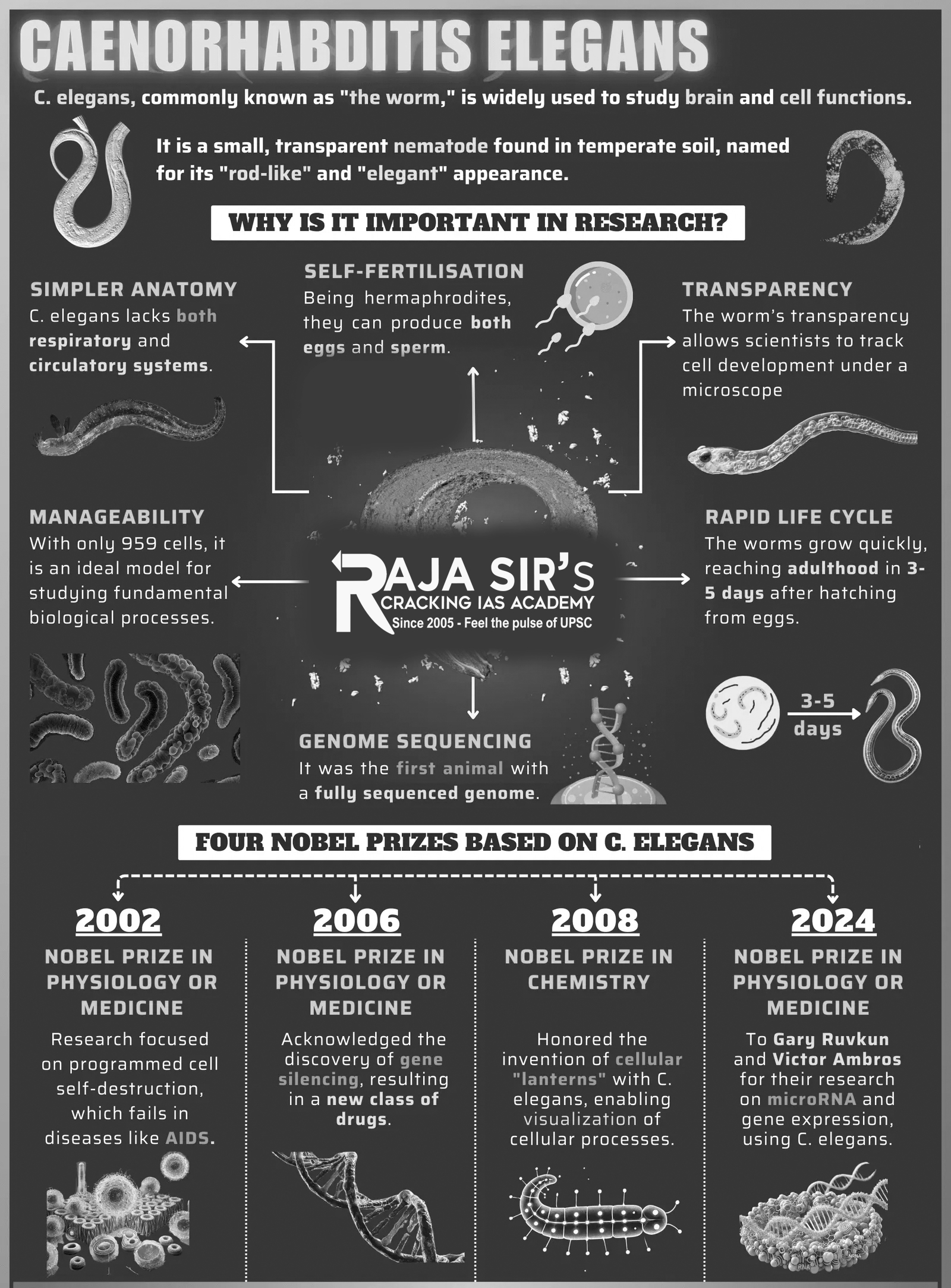 Caenorhabditis elegans, also called “the worm,” is used a lot in science to study how brains and cells work.
- It was the first animal to have all its genes and brain connections figured out.
- These worms grow fast and become adults in just 3-5 days after being born from eggs.
Caenorhabditis elegans is a small, transparent nematode. It lives freely in temperate soil environments.
- The name C. elegans comes from a blend of Greek and Latin words meaning “recent,” “rod-like,” and “elegant.”
- Key Traits of Caenorhabditis elegans:
- C. elegans is an unsegmented pseudocoelomate organism, meaning it lacks segmented body divisions and has a fluid-filled body cavity.
- It does not have respiratory or circulatory systems, distinguishing it from more complex organisms.
|
Nematodes
|
- The majority of Caenorhabditis elegans individuals are hermaphrodites, capable of producing both eggs and sperm.
- However, there are also a few males among the population.
- Male Caenorhabditis elegans possess unique tails specialized for mating, which include spicules, structures used during copulation.
Pseudomonas vranovensis
- Pseudomonas vranovensis is a harmful bacteria found where Caenorhabditis elegans naturally lives.
- This bacterium produces a tiny molecule called sRNA.
- When the worms eat this bacterium, they also take in the sRNA.
- The sRNA changes the worms’ eating habits so they avoid the harmful bacteria in the future.
- P. mendocina:
- P. mendocina, another bacterium in C. elegans’ habitat, is not harmful but a food source.
- Worms trained to avoid pathogenic P. vranovensis also avoided feeding on non-pathogenic P. mendocina.
- Researchers suggest that the “loss of memory” around the fifth generation might occur to re-learn the advantage of consuming P. mendocina.
DNA and RNA
- DNA is like a ladder made of phosphate and sugar molecules.
- Each sugar unit is attached with four types of chemical bases: adenine (A), cytosine (C), guanine (G), and thymine (T).
- P. vranovensis bacteria have about 6-7 million rungs in their DNA.
- It contains around 5,500 genes.
- Each gene provides instructions for making a protein.
- RNA is similar to a half-ladder or a comb, with a spine made of phosphate and sugar molecules, and four types of bases: A, C, G, and uridine (U).
- During a process called transcription, a cell copies the sequence of bases in a gene from DNA to RNA.
- This RNA, known as messenger RNA (mRNA), carries the genetic information to ribosomes.
- sRNA and Gene Expression:
- Some genes produce sRNA instead of mRNA and proteins.
- sRNA can interact with proteins and other RNAs.
- It influences gene expression positively or negatively.
- Experiment with C. elegans:
- Researchers at Princeton University discovered that C. elegans worms ingested a 124-tine sRNA from P. vranovensis bacteria.
- This sRNA reduced the expression of a gene called maco-1 in the worms.
- It is also found in humans and plays a crucial neurological role.
Link between Caenorhabditis elegans and Human Genome:
- Genes identified in Caenorhabditis elegans that affect its development are also found in the human genome.
- Mutations in these genes have been linked to limb deformities in humans.