



Daily Current Affairs | 10th May 2020
India rejects Nepal’s objections to link road for Kailash Mansarovar through Lipulekh pass
Nepal has strongly objected to the newly inaugurated link road which connects Pithoragarh (Uttarakhand) to Lipulekh pass (China border) significantly reducing the time of Kailash Mansarovar Yatra.
- Nepal claims the territory at the Lipulekh pass around 400 sq km area east of Kali river in the tri-junction of Nepal, Tibet and India, through which the road passes as its own.
- Nepal's Stand
- Nepal referred to
the 2014 agreement between Prime Ministers of both countries,
for Foreign Secretaries to work out the “outstanding boundary issues”
on Kalapani (where Lipulekh lies) and Susta (bordering
Bihar).
- According to Nepal’s Foreign Ministry, the unilateral decision to build a road there, is a breach of the 2014 agreement.
- For evidence, Nepal has
the maps during the 1816 Sugauli treaty and other
complementing treaties that followed, fixing that Limpiadhura,
Kalapani and Lipulekh were shown east of Kali
river and part of Nepal.
- These arrangements were made following Nepal’s war with the British due to which Nepal had to cede a large part of territory which currently forms the present Uttarakhand.
- Nepal seeks to question China as well because China and India had signed an agreement in May 2015 to develop Lipulekh as a commercial passage without consulting Nepal which majorly affected the triangulation of the countries.
- The government of Nepal remains committed to seek diplomatic solutions to the boundary issues on the basis of historical treaty, documents, facts and maps in keeping with the spirit of close and friendly bilateral ties between the two countries.
- Nepal referred to
the 2014 agreement between Prime Ministers of both countries,
for Foreign Secretaries to work out the “outstanding boundary issues”
on Kalapani (where Lipulekh lies) and Susta (bordering
Bihar).
Kali River
- It is also known as Sharda river or Kali Ganga in Uttarakhand.
- It joins Ghagra river in Uttar Pradesh, which is a tributary of Ganga.
- River Projects: Tanakpur hydro-electric project, Chameliya hydro-electric project, Sharda Barrage.
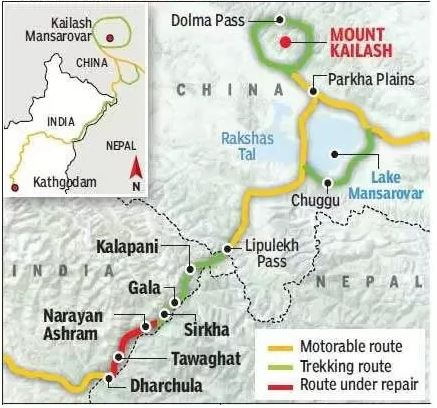
Lipulekh Pass
- It is also known as Lipu-Lekh Pass/Qiangla or Tri-Corner is a high altitude mountain pass situated in the western Himalayas with a height of 5,334 metre or 17,500 feet.
- It is an International mountain pass between India, China and Nepal.
- India’s Response
- According to India’s Ministry of External Affairs, the road going through Pithoragarh lies completely within the territory of India.
- The road follows the pre-existing route used by the pilgrims of the Kailash Mansarovar Yatra which has been made pliable for the ease and convenience of pilgrims, locals and traders, under the present project.
- India held that the boundary delineation exercise with Nepal is in process and it is committed to resolving outstanding boundary issues through diplomatic dialogue.
- Other Issues
- In November 2019, Nepal protested against the publication of Indian maps that included the Kalapani area.
- However, India rejected Nepal’s contention, asserting that the map accurately depicts the sovereign territory of India.
- Both nations are in the process of scheduling foreign secretary-level talks, which will be held once dates are finalised after the two governments have successfully dealt with the challenge of Covid-19.
India’s Infant Mortality at 32 per 1,000 Live Births, Kerala in Single Digits
Recently, the Registrar General of India released data related to birth rate, death rate and infant mortality rate in its Sample Registration System (SRS) bulletin for 2018.
- The rates are calculated per one thousand of the population.
- Birth rate:
- India’s birth rate has declined drastically over the last four decades from 36.9 in 1971 to 20.0 in 2018.
- The rural-urban differential has also narrowed. However, the birth rate has continued to be higher in rural areas compared to urban areas.
- Bihar (26.2) continues to remain at the top of list in birth rate while Andaman and Nicobar (11.2) is at the bottom.
- Birth rate is a crude measure of fertility of a population and a crucial determinant of population growth.
- Death rate:
- The death rate of India has witnessed a significant decline over the last four decades from 14.9 in 1971 to 6.2 in 2018.
- In the last decade, death rate at an all-India level has declined from 7.3 to 6.2.
- The decline has been steeper in rural areas.
- Chhattisgarh has the highest death rate at 8 and Delhi, an almost entirely urban state, has a lowest death rate of 3.3.
- Mortality is one of the basic components of population change. The data related to it is essential for demographic studies and public health administration.
- Infant mortality rate:
- IMR has decreased to 32 about one-fourth as compared to 1971 (129).
- The IMR at an all-India level has declined from 50 to 32 in the last decade.
- Madhya Pradesh has the highest IMR of 48 and Nagaland has the lowest IMR of 4.
- Infant mortality is the number of deaths of children under one year of age per 1000 live births.
Sample Registration System
- The SRS is a demographic survey for providing reliable annual estimates of infant mortality rate, birth rate, death rate and other fertility and mortality indicators at the national and sub-national levels.
- It was initiated on a pilot basis by the Registrar General of India in a few states in 1964-65, it became fully operational during 1969-70.
- The field investigation consists of continuous enumeration of births and deaths in selected sample units by resident part time enumerators, generally anganwadi workers & teachers, and an independent survey every six months by SRS supervisors. The data obtained by these two independent functionaries are matched.
Registrar General of India
- Registrar General of India was founded in 1961 by the Government of India under the Ministry of Home Affairs.
- It arranges, conducts and analyses the results of the demographic surveys of India including Census of India and Linguistic Survey of India.
- The position of Registrar is usually held by a civil servant holding the rank of Joint Secretary.
RBI gold reserves up 40.4 tonnes in 2019-20, more than half of total holdings held overseas
According to the ‘Report on Management of Foreign Exchange Reserves’, the Reserve Bank of India’s total holdings of gold reached 653.01 tonnes in the financial year 2019-20.
- The Reserve Bank of India publishes half-yearly reports on management of foreign exchange reserves as part of its efforts towards enhanced transparency and levels of disclosure.
- These reports are prepared half yearly with reference to the position as at end-March and end-September each year.
- The RBI’s total gold reserves were 612.56 tonnes in the preceding fiscal ended March 2019.
- The addition of 40.45 tonnes of gold has raised the value of gold reserves to $30.57 billion by March 2020 from $23.07 billion in March 2019.
- The share of
gold in the total foreign exchange (forex) reserves rose from about
5.59% as of March 2019 to about 6.40% by March 2020.
- India’s Forex Reserve include: Foreign Currency Assets, Gold reserves, Special Drawing Rights and Reserve position with the International Monetary Fund (IMF)
- Around 360.71 tonnes of gold is held overseas in safe custody with the Bank of England and the Bank for International Settlements, while the remaining gold is held domestically.
- The gold reserves will help the central banks around the globe to focus on the measures needed to contain the economic impact of Covid-19.
- Gains or losses on
valuation of foreign currency assets and gold due
to movements in the exchange rates and/or price of gold are booked under
a balance sheet head named the Currency and Gold
Revaluation Account (CGRA).
- CGRA represents the value of the gold and foreign currency that the RBI holds on behalf of India.
- It shows funds that are available to compensate RBI’s loss in the value of gold and foreign exchange reserve holdings.
- The balances in CGRA provide a buffer against exchange rate/gold price fluctuations.
Gold & Economy
- As Currency:
- Gold was used as the world reserve currency up through most of the 20th century. The United States used the gold standard until 1971.
- The paper money had to be backed up by equal amounts of gold in their reserves.
- Although the gold standard has been discontinued, some economists feel that we should return to it due to the volatility of the U.S. dollar and other currencies.
- As a hedge against
inflation:
- The demand for gold increases during inflationary times due to its inherent value and limited supply. As it cannot be diluted, gold is able to retain value much better than other forms of currency.
- Strength of Currency:
- When a country imports more than it exports, the value of its currency will decline.
- On the other hand, the value of its currency will increase when a country is a net exporter.
- Thus, a country that
exports gold or has access to gold reserves will see an increase in the
strength of its currency when gold prices increase, since this increases the
value of the country's total exports.
- Since, the central banks rely on printing more money to buy gold, they create an excess supply of the currency. This increases the supply and thereby reduces the value of the currency used to purchase it.
PM remembers freedom fighter, social reformer Gopal Krishna Gokhale on his 154th birth anniversary
The Prime Minister paid tribute to Gopal Krishna Gokhale on his 154th birth anniversary.
- Gopal Krishna Gokhale was a great social reformer and educationist who provided exemplary leadership to India's freedom movement.
- Birth: Gopal Krishna Gokhale was born on 9 May 1866 in Kotluk village in present-day Maharashtra (then part of the Bombay Presidency) in a Brahmin family.
- Ideology:
- Gokhale worked towards social empowerment, expansion of education , struggle for freedom in India for three decades and rejected the use of reactionary or revolutionary ways.
- Role in Colonial
Legislatures:
- Between 1899 and 1902, he was a member of the Bombay Legislative Council followed by work at the Imperial Legislative Council from 1902 till his death (1915).
- At the Imperial legislature, Gokhale played a key role in framing the Morley-Minto reforms of 1909.
- Role in INC:
- He was associated with the Moderate Group of Indian National Congress (joined in 1889).
- He became president of
INC in 1905 in Banaras session.
- This was the time when bitter differences had arisen between his group of ‘Moderates’ and the ‘Extremists’ led by Lala Lajpat Rai and Bal Gangadhar Tilak among others. The two factions split at the Surat session of 1907.
- Despite the ideological difference, in 1907, he intensely campaigned for the release of Lala Lajpat Rai, who was imprisoned that year by the British at Mandalay in present-day Myanmar.
- Related Societies and
Other Works:
- He established the Servants of India Society in 1905 for the expansion of Indian education.
- He was also associated with the Sarvajanik sabha journal started by Govind Ranade.
- In 1908, Gokhale founded the Ranade Institute of Economics.
- He started english weekly newspaper, The Hitavada (The people's paper).
- Mentor to Gandhi:
- As a liberal nationalist, he is regarded by Mahatma Gandhi as his political guru.
- Gandhi wrote a book in Gujarati dedicated to the leader titled ‘Dharmatma Gokhale’.
Toda embroidered masks help in the fight against COVID-19
In the wake of the Covid-19, Toda artisans from the Nilgiris have come forward to use their traditional skills in making face-masks and to help people ward off the infection and also provide Todas with livelihood.
- Toda Tribe is a pastoral tribe of the Nilgiri Hills of southern India.
- The Toda language is Dravidian but is the most unusual and different among the languages belonging to the Dravidian family.
- They live in settlements of from three to seven small thatched houses.
- They traditionally trade dairy products, as well as cane and bamboo articles, with the other Nilgiri peoples.
Toda Embroidery
- In the Toda language it is called pohor.
- The traditional Toda
dress is a distinctive shawl which is called putukuli.
- Considered a grand garment, it is only worn for special occasions like visits to the temple, festivals and finally as a shroud.
- The embroidery is done by Toda women and has distinctive red and black (and occasionally blue) thread work in geometric designs on unbleached white cotton fabric.
- It has got a Geographical Indications (GI) Tag.