




Daily Current Affairs | 21st April 2020
Daily Current Affairs | 21st April 2020
How COVID-19 is hurting the rupee’s exchange rate with other currencies?.
Exchange Rate:
- A currency’s exchange rate vis-a-vis another currency reflects the relative demand among the holders of the two currencies.
- This is dependent on the relative demand for the goods and services of the two countries.
- If the US dollar is stronger than the rupee, then it shows that the demand for dollars (by those holding rupee) is more than the demand for rupees (by those holding dollars)
Current Scenario:
- Typically, stronger
economies have stronger currencies.
- For instance, the US economy is relatively stronger than India’s and this is reflected in one US dollar being equal to around 76 rupees.
- The rupee has been losing value (or depreciating or weakening) against the dollar over the past few months.
- But the US is not the only other country in the world; India trades with many other countries.
- To have a better understanding of the Indian economy’s overall competitiveness, one should look at how the rupee is behaving with its major trade partners.
Parameters to measure exchange rate competitiveness of Indian Economy:
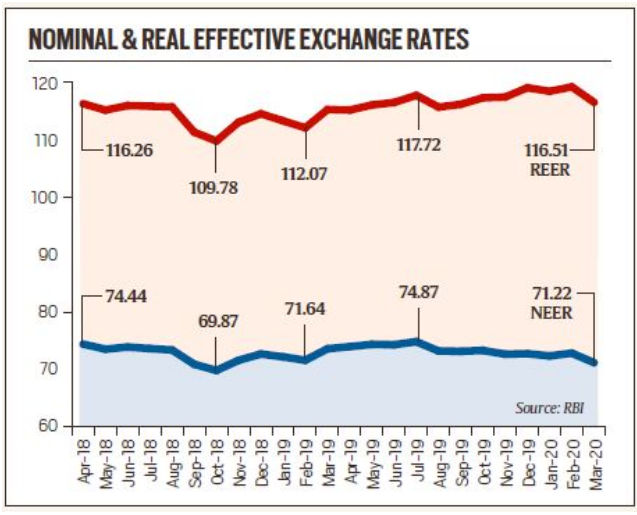
- Nominal Effective Exchange Rate: The Reserve Bank of India tabulates the rupee’s NEER in relation to the currencies of 36 trading partner countries.
- This is a weighted index — that is, countries with which India trades more are given a greater weight in the index.
- A decrease in this index denotes depreciation in rupee’s value; an increase reflects appreciation.
- Changes Observed:
- In NEER terms, the rupee has depreciated to its lowest level since November 2018.
- The rupee has been steadily losing value — showing the Indian economy’s reducing competitiveness— since July 2019.
- The dip in March was likely influenced by the net outflow of foreign portfolio investments from the Indian equity and debt markets — they stood at $15.92 billion in March as against net inflows of $1.27 billion in February.
- Real Effective Exchange Rate(REER): This is even better at capturing the actual change is essentially an improvement over the NEER because it also takes into account the domestic inflation in the various economies.
- Many factors affect the exchange rate between any two currencies ranging from the interest rates to political stability (less of either results in a weaker currency). Inflation is one of the most important factors.
- REER calculates the purchasing power of a currency by adjusting the nominal exchange rate for inflation effects.
- Illustration - Suppose Rupee - Dollar exchange rate was exactly 10 in the first year.
- This means that with Rs 1000, one could buy something that was priced at $100 in the US. But suppose the Indian inflation is 20% and the US inflation is zero. Then, in the second year, an Indian would need Rs 1200 to buy the same item priced at $100, and the rupee’s exchange rate would depreciate to 12.
- Changes Observed:
- Even in REER terms, the rupee has depreciated in March and fallen to its lowest level since September 2019.
- As the graph shows, the difference between trends of NEER and REER was due to India’s domestic retail inflation being lower relative to the other 36 countries.
- As domestic inflation started rising, the REER, too, started depreciating like the NEER.
- Gross Domestic Product (GDP) is a measure of economic activity in a country. It is the total value of a country’s annual output of goods and services. It gives the economic output from the consumers’ side.
- Gross Value Added (GVA) is the sum of a country’s GDP and net of subsidies and taxes in the economy. It provides the rupee value for the amount of goods and services produced in an economy after deducting the cost of inputs and raw materials that have gone into the production of those goods and services.
April 21 - Civil Services Day: Why is it celebrated?
- Every year, 21st April is celebrated as the Civil Services Day by the Government of India.
- It is celebrated as an occasion for the civil servants to rededicate themselves to the causes of citizens and renew their commitments to public service and excellence in work.
- The date is chosen to
commemorate the day when the first Home Minister of Independent
India, Sardar Vallabhbhai Patel addressed the probationers of
Administrative Services Officers in 1947 at Metcalf House, Delhi.
- He referred to civil servants as the ‘Steel Frame of India’.
- The first function on civil services day was held in Vigyan Bhawan, New Delhi in 2006.
- On this day, the Prime
Minister’s Awards for Excellence in Public Administration are
presented to Districts/Implementing Units for implementation of Priority
programme and innovation categories.
- These awards bring together civil servants to connect with each other and learn the good practices being implemented across the nation in the field of public grievance.
Sardar Vallabhbhai Patel
- He was born on 31st October, 1875 in Nadiad, Gujarat.
- He was the first Home Minister and Deputy Prime Minister of independent India.
- He played an important role in
the integration of many Indian princely states to make an Indian
federation.
- At the time of independence, he played a key role in convincing several princely states to align with the Indian Union.
- He also worked hard as a social leader for the independence of India.
- Women of Bardoli bestowed the title ‘Sardar’ on Vallabhbhai Patel, which means ‘a Chief or a Leader’.
- He is recognized as the real unifier of India for his colossal contribution to integrate and make India a united (Ek Bharat) and an independent nation.
- He requested the people of India to live together by uniting in order to create Shresth Bharat (Foremost India).
- He is also remembered as the ‘Patron saint of India’s civil servants’ as he established the modern all-India services system.
- The Statue of Unity at Kevadiya in Narmada district of Gujarat was built in his honour.
BRO finishes construction of key bridge over Daporijo river in Arunachal Pradesh
The Border Roads Organisation (BRO) constructed the Daporijo bridge over Subansiri river in Arunachal Pradesh in a record span of just 27 days.
- The bridge is of utmost importance in strategic connectivity as it links roads leading upto the Line of Actual Control (LAC) between India and China.
- Subansiri
River
- Subansiri River (gold river), originates in the Tibet Plateau and enters India through Miri hills in Arunachal Pradesh.
- It is the largest tributary of Brahmaputra River.
Border Roads Organisation
- It was conceived and raised in 1960 by Pandit Jawaharlal Nehru for coordinating the speedy development of a network of roads in the North and the North Eastern border regions of the country.
- It works under the administrative control of the Ministry of Defence.
- BRO is regarded as a symbol of nation-building, national integration and an inseparable component in maintaining the security and integrity of the country.
- It has diversified into a large spectrum of construction and development works comprising airfields, building projects, defence works and tunneling and has endeared itself to the people.
Posted on 21-04-2020 • By Admin