Feb 03, 2022
INDIA’S ‘RETURN’ TO CENTRAL ASIA
- India-Central Asia Dialogue, and the Regional Security Dialogue on Afghanistan has collectively indicated a renewed enthusiasm in New Delhi to engage the Central Asian region.
- India has limited economic and other stakes in the region, primarily due to lack of physical access.
- India’s mission Central Asia today reflects, and is responsive to, the new geopolitical, if not the geo-economic, realities in the region.
- India’s renewed engagement of Central Asia is in the right direction for the simple reason that while the gains from an engagement of Central Asia may be minimal, the disadvantages of non-engagement could be costly in the longer run.
Great power dynamics

- The decline of American presence and power in the broader region (due primarily to the U.S. withdrawal from Afghanistan) has led to a reassertion by China and Russia seeking to fill the power vacuum.
- While China dominates the geo-economic landscape, Russia is the dominant politico-military power in the region.
- But in the end, geo-economics might gain more traction. A somewhat anxious Moscow considers India to be a useful partner in the region.
- For the U.S., while growing India-Russia relations is not a welcome development, it recognizes the utility of Moscow-New Delhi relations in Central Asia to offset Beijing’s ever-growing influence there.
- As for China, India’s engagement of the region and the growing warmth in India-Russia relations are not a cause for concern yet, but they could be eventually.
- For New Delhi, it is about breaking out of a continental nutcracker situation it finds itself in.
- In the wake of the U.S. withdrawal from Afghanistan, New Delhi faces a major dilemma in the wider region, not just in the pre-existing theatres like the Line of Control and the Line of Actual Control.
- There are growing and legitimate concerns within the Indian strategic community that India in the region might get further hemmed in due to the combined efforts by China, Pakistan and Taliban-led Afghanistan.
- India must ensure that there is no China-led strategic gang up with Pakistan and the Taliban against India in the region, which, if it becomes a reality, would severely damage Indian interests.
Focus on Afghanistan
- India’s engagement of Central Asia would also help it to consolidate its post-American Afghan policy.
- New Delhi is forced to devise new ways of engaging Afghanistan and that’s where the Central Asian Republics (CARs) and Russia could be helpful.
- Tajikistan holds immense geopolitical significance for India given its location bordering Afghanistan as well as its close geographical proximity to Pakistan-occupied Kashmir.
- The announcement of a Joint Working Group on Afghanistan during the summit between India and the CARs is surely indicative of such interest.
Challenges in Central Asian Republics (CARs)
- China, which shares a land border with the region, is already a major investor there.
- China is the region’s most important economic partner, a reality that worries Russia and sharpens India’s relative irrelevance in the region.
- India’s best shot at reaching the CARs is by using a hybrid model – via sea to Chabahar and then by road/rail through Iran (and Afghanistan) to the CARs.
- India’s ongoing outreach to Iran and the now-postponed visit of the Iranian foreign minister to New Delhi help repair some of the damage done to the relationship over the years.
BEIJING 2022: CAN CHINA DELIVER CLEAN WINTER OLYMPIC GAMES
- The promise of a ‘green and clean’ winter Olympics by China is one that looks increasingly unlikely with the start of the Games looming closer.
- A combination of global warming and poor water conservation policies have cast a shadow on not just Beijing’s attempt at holding the Winter Olympics.
How artificial Snow is produced:
- The basic principle of snow-making systems was discovered by chance at the end of the 1940s: an American researcher sprayed water into a wind tunnel at low temperatures to investigate the icing of jet engines.
- This caused it to produce snow unexpectedly. Since then, this effective principle for snow generation has been used successfully in winter tourism.
- The snow gun's core element is a large propeller, which is supplied with water and electricity and generates a strong flow of air.
- The water is sprayed through nozzles in front of the propeller and transported from the compressed air stream to the cold, dry winter air.
- Depending on the weather conditions, the size of the water droplets can be adjusted to produce the best possible artificial snow.
Environmental concerns of creating Artificial Snow
- The issue of creating such large amounts of artificial snow has raised the hackles of environmentalists.
- They have raised concerns over the environmental sustainability of this process, as man-made snow requires thousands of litres of water and kilowatts of energy.
- This more troubling for China as a 2020 study warned that groundwater depletion in northern China was a "critical issue" and among the highest globally, due to intensive agricultural irrigation, rapid urbanisation, and a dry climate.
- Environmentalists have also raised concerns about proximity to the 4,600-hectare Songshan National Nature Reserve.
WHAT IT MIGHT TAKE FOR THE IRAN NUCLEAR DEAL TO BE REVIVED
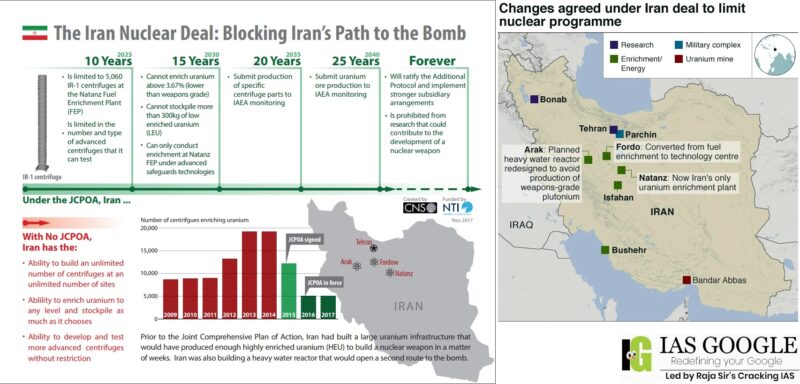
- Western diplomats have set a deadline of later this month to revive the 2015 Iran nuclear deal, signed under President Barack Obama, and dismantled in 2018 by President Donald Trump.
 Reason:
- Iran’s rapid nuclear escalation after the US abandoned the deal, and ballistic missile stockpiles and the proxy conflicts that it backs across the region.
Iran’s response:
- Iran has rejected any deadline imposed by the West and replied “regional and missile issues are non-negotiable”.
- The U.S. State Department is waiving sanctions on Iran’s civilian nuclear programme in a technical step necessary to return to the 2015 nuclear agreement.
Need for the resumption of the waiver?
- It is essential to ensuring Iran’s swift compliance” if a new deal on controlling Tehran’s nuclear programme can be reached in talks in Vienna.
Repercussions of waiving the sanctions?
- It allows other countries and companies to participate in Iran’s civilian nuclear programme without triggering U.S. sanctions on them, in the name of promoting safety and non-proliferation.
Iran’s civilian programme?
- The civilian programme includes Iran’s increasing stockpiles of enriched uranium.
- It helps in detailed technical discussions with third parties regarding disposition of stockpiles and other activities of non-proliferation.
Who are participating in Vienna talks and on what topics are going to be discussed?
- Political decisions: The Vienna talks, which include Iran, the United States, Britain, China, France, Germany and Russia, are at a key stage where the parties have to make “critical political decisions,”.
- Technical discussions: That are to be discussed in Vienna will be facilitating the waiver on sanctions that are to be discussed in the final weeks of Joint Comprehensive Plan of Action (JCPOA).
- The U.S. official insisted that the move was not “part of a quid pro quo,” as the partners in the JCPOA talks await Iran’s response.
How good is the move?
- Not a sweeping measure: This U.S. sanctions waiver for the civilian nuclear programme is not broader sanctions or a relief.
What is 2015 Iran nuclear deal?
- Iran nuclear deal formally known as Joint Comprehensive Plan of Action (JCPOA), is a l accord signed between Iran and US, the UK, China, Russia, France, and Germany (collectively known as P5+1).
- The then President Hassan Rouhani (relatively moderate) agreed to dismantle much of Iran’s nuclear programme, and open its facilities to greater international monitoring.
What would Iran get in return?
- In return, the world powers agreed to lift many of the sanctions imposed on the country, Economic: Opening its economy to billions of dollars of lost revenue.
- Scientific: Iran was at a point from where it could build a weapon in approximately three months the sanctions by the world powers restricted Iran’s nuclear capabilities to the point that it would take Tehran at least a year to build a weapon, giving them adequate time to prepare and respond.
Terms and aims of the agreement:
- It is complex, in essence, focused on eliminating Iran’s stockpiles of enriched uranium and plutonium (needed to produce a nuclear weapon).
- To limit the number and type of centrifuges Iran could operate.
- A protocol that would allow inspectors from the International Atomic Energy Agency (IAEA) to access its nuclear sites to ensure Iran would not be able to develop nuclear weapons in secret.
- Many of the JCPOA’s restrictions have expiration dates, something that the opponents of the deal flagged.
Not all sanctions lifted?
| Sanctions that got lifted |
Sanctions that remained |
| While the West agreed to lift sanctions related to Iran’s nuclear proliferation. |
The sanctions addressing alleged abuses of human rights and Tehran’s ballistic missile programme remained in place.
|
| US committed to lifting sanctions on oil exports. |
The US continued to restrict financial transactions, which have deterred international trade with Iran. |
What is the benefit for Iran, despite not all sanctions not being lifted?
- Iran’s economy, after suffering years of recessions, currency depreciation, and inflation, stabilised significantly after the deal took effect,
- Its exports skyrocketed.
How was the regional rival’s response on the waiver?
- Israel, strongly rejected the deal.
- Saudi Arabia, complained that they were not involved in the negotiations even though Iran’s nuclear programme posed security risks for every country in the region.
- Critics point out that since 2015, Iran has increased its support for regional proxies, and the Islamic Revolutionary Guard Corps (IRGC), a US designated a terrorist organisation, has expanded its activities.
What was the reply from Supporters of the deal?
- The backers of the deal believe that it succeeded in its main objective, which was to contain Iran’s nuclear capabilities.
What happened after Trump abandoned the deal and reinstated banking and oil sanctions?
- Iran ramped up its nuclear programme in earnest, returning to approximately 97 per cent of its pre-2015 nuclear capabilities.
What happened after US pulled out of the deal in April 2020?
| USAs move against the deal |
Other powers move to counter US |
| In April 2020, under Trump’s presidency, US announced its intention to snap back sanctions. |
However, the other partners objected to the move, stating that since the US was no longer part of the deal, it could not unilaterally reimpose sanctions. |
| |
Initially several countries continued to import Iranian oil under waivers granted by the Trump administration. |
| A year later, the US ended the waivers and, significantly curbed Iran’s oil exports. |
The other powers, to keep the deal alive, launched a barter system known as INSTEX to facilitate transactions with Iran outside the US banking system. |
| INSTEX only covered food and medicine, which were already exempt from US sanctions. |
Iran announced new restrictions on the IAEA’s ability to inspect facilities, and later ended its monitoring agreement with the agency. |
| Trump claimed to bring Iran back to the negotiating table and accept harsher terms. |
Iran doubled down on its nuclear and military activities in the region, and evade sanctions by smuggling oil to buyers including China. |
- However still, the new US sanctions hit the Iranian economy hard, leading to a wave of protests across the country.
Geopolitical considerations that should drive the deal forward:
- The US would have to factor in not only Iran’s nuclear programme but also its increasingly hostile behavior in the region.
- Consideration of the reality of the new multipolar world has to be taken in which its unilateral leadership is no longer guaranteed.
- Iran, have to consider the rapidly changing dynamics in the Middle East, given that Israel has recalibrated its relations with several Middle Eastern Arab countries in recent years.
Road Ahead:
- In internal political dynamics both Iran and the US have a role to play. The move towards reviving the deal was progressing and has to be carried forward.
VETERAN SINGER LATA MANGESHKAR DEAD, SHE LIVES IN HER SONGS
Acclaimed singer Lata Mangeshkar breathed her last at Breach Candy Hospital, Mumbai on Sunday. She was 92. The singer, called the Nightingale of India, was admitted to the hospital in January with Covid-19 and pneumonia.
 Lata Mangeshkar?
- Lata Mangeshkar (born Hema Mangeshkar; 28 September 1929 – 6 February 2022) was an Indian playback singer and music composer. Daughter of Pandit Deenanath Mangeshkar and Shevanti Mangeshkar, Lata belonged to a musical family. Her father was a well-known Marathi musician and theatre artiste. She was first tutored by her father and later appeared as a child artiste in several of his plays.
- She is widely considered one of the greatest and most influential singers in India.
- Her contribution to Indian music industry in a career spanning seven decades gained her honorific titles such as the Nightingale of India, Voice of the Millennium and Queen of Melody.
- Lata Mangeshkar recorded her first Hindi song called “Mata Ek Sapoot Ki Duniya Badal De Tu” for the Marathi feature Gajaabhaau, which had released in 1943.
Some notable achievements:
- Lata had recorded songs in over thirty-six Indian languages and few foreign languages, though primarily in Hindi and Marathi.
- In 1987 the Dadasaheb Phalke Award.
- In 2001, Bharat Ratna, India's highest civilian honour and is only the second female singer, after M. S. Subbulakshmi, to receive this honour.
- France conferred on her its highest civilian award, Officer of the National Order of the Legion of Honour, in 2007.
- In 1974, she became the first Indian to perform at Royal Albert Hall, London.
Guinness controversy
| In 1974, The Guinness Book of Records listed Lata Mangeshkar as the most recorded artist in history, stating that she had reportedly recorded "not less than 25,000 solo, duet and chorus backed songs in 20 Indian languages" between 1948 and 1974. |
Her record was contested by Mohammad Rafi, who was claimed to have sung around 28,000 songs. |
| After Rafi's death, in its 1984 edition, the Guinness Book of World Records stated Lata Mangeshkar's name for the "Most Recordings", but also stated Rafi's claim. |
The later editions of Guinness Book stated that Lata Mangeshkar had sung no fewer than 30,000 songs between 1948 and 1987. |
| Mangeshkar herself has stated that she does not keep a record of the number of songs recorded by her, and that she did not know from where Guinness Book editors got their information. |
The entry was discontinued by Guinness editions in 1991 without explanation, while several sources continued to claim that she recorded thousands of songs, with estimates ranging up to figures as large as 50,000. |
| |
In 2011, the entry was revived by Guinness crediting the record to her sister Asha Bhosle as the most recorded artist in music history, "for recording up to 11,000 solo, duet and chorus-backed songs and in over 20 Indian languages since 1947". |
| |
Since 2016, current record in this category belongs to P. Susheela, for recording at least 17,695 songs in 6 languages, not counting some lost early recordings. |
BETTER HABITAT MANAGEMENT HELPS TIGERS FLOURISH IN SARISKA
The present Tiger population in Sariska Tiger Reserve is now 25, where once the tiger population became extinct. The measures for habitat management for tigers was launched about six months ago at the famous Sariska Tiger Reserve in Rajasthan’s Alwar district have started bearing fruit.
 Initiatives taken to increase the tiger population in the wildlife sanctuary:
- Creation of water holes and development of grasslands for ungulates as a prey base. The forest was now depicting an appropriate balance between the prey and predator.
- The grassland habitats developed in dry patches of land have helped ungulates to feed better and breed in the areas such as Naya Pani, Dabli and Bhagani, leading to enhanced feed for tigers.
Sustainable Habitat:
New tourist route
- The forest administration has opened a new route in the tiger reserve’s buffer zone, adjacent to Alwar town, for tourists to facilitate better sightings of the big cats.
- The new Bara-Liwari route, will reduce pressure on the core area and increase livelihood opportunities for the rural population.
Social initiatives in protection of the big cats:
- A foundation of a private bank as part of its corporate social responsibility expenditure has started delivering goods and resources which the Forest Department could not arrange because of a variety of handicaps.
- The foundation is funding development of grasslands, earthen bunds and water holes for wild animals at 10 locations.
- Rehabilitation: The foundation is making livelihood intervention for the villagers being relocated from the sanctuary.
Genesis:
- The tiger reserve, spread across 1,216 sq. km, witnessed the first-of-its-kind tiger relocation from the Ranthambore National Park in 2008 after the felines became extinct in the sanctuary.
- Since then, the animal has taken some time in multiplying at its own ease.
- Incentives that act as catalyst to perform the duties is welcomed:
- The foundation has distributed 23 motorcycles with helmets to the forest guards in Sariska for monitoring the tiger movement with the pledge that one new motorcycle per new tiger will be given in the future.
Achievements:
- Four years ahead of its goal: India achieved a remarkable feat by doubling the country’s tiger population from 2006 in 2018, four years ahead of its goal.
- Fund: The budgetary allocation for tiger conservation has increased from Rs. 185 crore in 2014 to Rs. 300 crores in 2022,
- Success with the tiger relocation could be replicated elsewhere:
- Tigers were successfully translocated in the western part of Rajaji Tiger Reserve last year.
- The SOP will be shared with all Tiger Range Countries
- The Conservation Assured | Tiger Standards (CA|TS) accreditation has been already awarded to 14 tiger reserves in India (Manas, Kaziranga, Orang, Satpura, Pench, Kanha, Panna, Valmiki, Dudhwa, Parambikulam, Mudumalai, Bandipur, Anamalai and Sundarbans).
What is CA | TS?
- CA|TS is a set of criteria which allows tiger sites to check if their management will lead to successful tiger conservation as per the international standards.
Who else have achieved CATS accreditation?
- Other than India, one tiger reserve each in Russia and Nepal, and two in Bhutan have the CAITS status.
Who are the Tiger Range Countries?
- India, Bangladesh, Vietnam, Cambodia, Bhutan, Thailand, Indonesia, Laos, China, Malaysia, Russia, Nepal and Myanmar.
Statistics:
- India has the highest number of tigers in the wild 2,967 tigers, or seven out of every 10 in the world, according to the All-India Tiger Estimation Results released in 2019. The number reflects a 33% increase over 2014 when there were 2,226 tigers in the country.
- NTCA has designated the combined areas of the Guru Ghasidas National Park and Tamor Pingla Wildlife Sanctuary as a Tiger Reserve. This will be the 53rd Tiger Reserve in India.
NTCA:
- NTCA is a statutory body under the Ministry of Environment, Forests and Climate Change, established in 2005 for strengthening tiger conservation.
- It was constituted under enabling provisions of the Wildlife (Protection) Act, 1972, as amended in 2006, for strengthening tiger conservation, as per powers and functions assigned to it.
- The Minister for Environment & Forests is the current Chairperson of the National Tiger Conservation Authority.
- Under section 38V (1) of the wild life Protection Act 1972, The state government shall on the recommendation of the tiger conservation authority, notify any area as a tiger reserve. So, it becomes mandatory for the state to accept the recommendation.
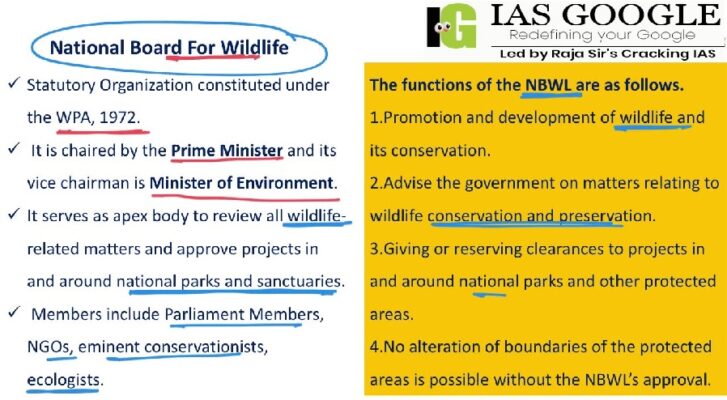
- No alteration of boundaries of a tiger reserve shall be made except on the recommendation of the NTCA and approved by the National Board of Wild Life.
- No state government can de-notify a tiger reserve except in public interest with the approval of the NBWL.
National Board for Wildlife (NBWL):
- The National Board for Wildlife (NBWL) is the apex body in India for all wildlife-related matters. It is primarily responsible for the promotion of wildlife conservation and the development of wildlife and forests.
- It is a statutory body constituted under Section 5A of the Wildlife (Protection) Act, 1972 (WLPA).
- It approves projects (including government projects) in and around the protected areas (national parks, wildlife sanctuaries, etc.).
- It is an advisory board and advises the central government on policy matters concerned with wildlife conservation in the country.
- The Board was constituted in 2003 under the WLPA, as mentioned before.
- It replaced the Indian Board for Wildlife, which was formed in 1952 as an advisory board.
- The NBWL is chaired by the Prime Minister.
Project Tiger
- Project Tiger is an ongoing Centrally Sponsored Scheme of the Ministry of Environment, Forests and Climate Change providing central assistance to the tiger States for tiger conservation in designated tiger reserves.
NC REJECTS DELIMITATION PANEL’S 2ND DRAFT PROPOSAL SUGGESTING NEW CONSTITUENCIES IN JAMMU & KASHMIR
The National Conference (NC) on February 5 rejected the second draft proposal of the Delimitation Commission which has suggested the creation of new constituencies and redrawing of others in Jammu and Kashmir.
Issue:
- The J&K Delimitation Commission has come out with a fresh interim report and the fresh proposal included redrawing of constituencies in the Union Territory as well as increasing the number of constituencies – six in Jammu and one in Kashmir.
- The panel has shared the report with its associate members, three MPs of the National Conference (NC) and two of the BJP.
What was the reason for rejection?
- NC lawmakers, rejected saying none of their suggestions of the earlier draft proposal, was incorporated in the fresh interim proposal and claimed the recommendations “unconstitutional”.
Was this rejection first time?
- No, earlier also, the party had rejected the first draft proposal by the panel which proposed to increase six Assembly seats in Jammu and one Assembly seat in Kashmir.
- The party had said its basic premise is that the exercise “offends constitutional morality, constitutional propriety and the constitutional values” in as much as it is required to make the exercise under The Reorganisation Act.
Delimitation Commission?
- Delimitation Commission under the Chairpersonship of Justice (Retd.) Mrs. Ranjana Prakash Desai, in the presence of Shri Sushil Chandra, Chief Election Commissioner has decided to visit the Union Territory of Jammu & Kashmir from 6th July, 2021 (Tuesday) to 9th July, 2021 (Friday). During this period, the Commission will interact with political parties, public representatives and Union Territory administration officials including District Election Officers/ Deputy Commissioners of 20 districts of the Union Territory to gather first-hand information and input concerning the on-going process of delimitation as mandated under the Jammu & Kashmir Reorganization Act, 2019.
- The Delimitation Commission was constituted in March 2020 and its term was extended by another year in March 2021 in view of the on-going pandemic.
| Kashmir-based parties like the NC, the PDP, the People’s Conference and the CPI (M) cite population to be taken as major parameter into consideration while redrawing the boundaries. |
Pro-Jammu parties term area and hilly terrain should be taken as a parameter for the purpose. The Jammu-based parties questions the 2011 Census and called the figures fudged to give an upper hand to Kashmir. |
Criticism:
PDPs: Panel acting as frontal organisation of BJP
- The interim recommendations of the commission were clear that the sole objective of the body was to ensure back-door entry of the BJP and its shadow organisations to the legislative assembly of J&K.
- The entire exercise is to disempower people of Jammu and Kashmir by division of secular and majority votes.
Pro BJP:
- The commission has proposed the redrawing of five of the eight Assembly segments in Srinagar.
- Example: The Habba Kadal seat, which has majority of Kashmiri Pandit voters, has been split into three.
Congress: Expresses strong reservations.
- The norms, criteria and ground realities besides aspirations of the people seem to have been ignored in the delimitation draft.
- The kind of divisions, clubbing of certain areas ignoring the ground realities and will result in worst inconvenience in most areas.
Norms, procedures being defied in the process:
- Publication of the draft delimitation report in the official gazette along with the objections of the associate members in pursuance meeting held in December 20, 2021 was a mandatory requirement as laid down in the relevant laws.
- The commission was authorised to accept or reject the objections in terms of the provisions contained in the Delimitation Act read with the J&K Reorganisation Act 2019.
- The submission of delimitation draft to associate members in the Parliament without publishing it in official gazette was in violation of Section 60 of the J&K Reorganisation Act and Section 9 of the Delimitation Act.
- With the associate members having already conveyed their objections between December 20 and December 31, 2021, in terms of the previous orders of the commission, it was legally inappropriate to once again seek suggestions from them without publishing the report along with their previous objections.
Response from the Commission on the rejection by National conference and other parties:
- The officials said the associate members had been asked to submit their objections by February 14. The commission was headed by retired Supreme Court judge Justice Ranjana Desai, was constituted under the J&K Reorganisation Act and its second term ends on March 6.
Road Ahead:
- The commission has to ensure complete fairness and transparency in its functioning without succumbing to the dictates of any political party. And time-bound completion of the delimitation process and immediate conduct of assembly elections so as to ensure installation of a “legitimate” elected government in J&K.
WHY ARE THE RISE IN IMPORTS FROM CHINA A CONCERN?
The need to reduce reliance on China particularly in the wake of COVID-19 and disruption to supply chains.
 India’s concern:
- While many countries, including India, have spoken of the need to reduce reliance on China:
- Economic concern: Trade figures released last month showed imports have only continued to surge in 2021, rebounding after the pandemic.
- Security concern: With the rising trade comes amid continuing tensions with China along the Line of Actual Control (LAC), where disengagement negotiations have been slow moving.
- Concern of stagnation: Areas, such as investment, remain in a deep freeze amid the continuing chill in bilateral relations.
India imports from China in 2021?
- China’s General Administration of Customs (GAC) Reported: India’s trade with China in 2021 reached $125.6 billion.
- First time that trade crossed the $100 billion mark.
- Exports to China: Slide up to 56%.
- Trade deficit: Jumped up by 22% since 2019, having declined last year (2020) but once again rebounding.
What is driving India’s imports?
- India imports are electrical and mechanical machinery.
- A range of chemicals that are intermediate imports used by industries, active pharmaceutical ingredients (APIs).
- Auto components.
- Since 2020, a large number of medical supplies.
- India’s Ministry of Commerce: All key imports continued to rise in 2021.
- Finished goods such as integrated circuits (up 147%), laptops and computers (up 77%).
- Oxygen concentrators (up four-fold).
- Intermediate products such as chemicals (of these, acetic acid imports were up eight-fold).
Recent trend of trade figures suggests?
- No signs of easing: India’s dependence on China for finished goods has shown no signs of easing, is a cause for concern.
- The rise in intermediate imports is, however, less of a concern as it is a sign of industrial recovery and greater demand for inputs.
What was the concern, despite rise on exports to China?
- Indian exports to China have also grown, up by more than 50% in the last two years, but these are mostly raw materials such as ores, cotton and seafood, and not finished products.
- Trade deficit: The five-year trend shows the trade deficit continues to widen (from $51.8 billion in 2017 to $69.4 billion in 2021.
Implications for India-China relations?
- LAC crisis April 2020: New Delhi’s message was that it cannot be business as usual while there are tensions along the border.
- Tighter curbs: Investments from China in the past year have plunged amid tighter curbs.
- Example: Investments in start-ups including from tech giants such as Alibaba and Tencent, has come to an abrupt halt, more than 200 apps remain banned, and Chinese firms have been kept out of 5G trials.
- China’s concern: “Provide a fair, transparent and non-discriminatory environment for Chinese businesses”.
- Scrutiny: India has also tightened scrutiny on Chinese firms in India, recently conducting tax investigations into smartphone manufacturer Xiaomi.
Road Ahead:
- The trade pattern is unlikely to dramatically change in the near future, as India considers a long-term plan to reduce some of these import dependencies by either accelerating which was on discussion for a long time. Better shift plans to manufacture critical goods in India or source elsewhere, while the rest of the India-China economic relationship remains in a state of freeze as talks continue to resolve the tensions along the border.
WHAT ARE RAMSAR SITES, AND WHAT IS THE SIGNIFICANCE OF THE LISTING?
 On the eve of the World Wetlands Day on 2 February 2022, the Ramsar Convention on Wetlands designated Khijadia Bird Sanctuary near Jamnagar in Gujarat and Bakhira Wildlife Sanctuary in Uttar Pradesh as wetlands of international importance.
Ramsar Convention on wetlands:
On the eve of the World Wetlands Day on 2 February 2022, the Ramsar Convention on Wetlands designated Khijadia Bird Sanctuary near Jamnagar in Gujarat and Bakhira Wildlife Sanctuary in Uttar Pradesh as wetlands of international importance.
Ramsar Convention on wetlands:
- The Ramsar Convention on wetlands, which came into existence in 1971, is an intergovernmental treaty that provides the framework for national action and international cooperation for the conservation and wise use of wetlands and their resources.
What are wetlands?
- The Ramsar Convention on Wetlands defines wetlands as “areas of marsh, fen, peat land or water, whether natural or artificial, permanent or temporary, with water that is static or flowing, fresh, brackish or salt, including areas of marine water the depth of which at low tide does not exceed six meters.”
- US Fish and Wildlife Service has adopted the definition given by Cowardin and others who defined wetland as, “are lands transitional between terrestrial and aquatic systems where the water table is usually at or near the surface or the land is covered by shallow water.
- The Wetlands (Conservation and Management) Rules, 2017 notified by the Union Ministry of Environment, Forest and Climate Change define wetlands as “area of marsh, fen, peatland or water; whether natural or artificial, permanent or temporary, with water that is static or flowing, fresh, brackish or salt, including areas of marine water the depth of which at low tide does not exceed six meters, but does not include river channels, paddy fields, human-made water bodies/ tanks specifically constructed for drinking water purposes and structures specifically constructed for aquaculture, salt production, recreation and irrigation purposes.”
What is the significance of Ramsar listing?
- It is like an ISO certification. They can take you off the list as well if you don’t meet their standards continuously.
- Ramsar tag makes it incumbent upon authority to strengthen the protection regime there and also creates defences against encroachment etc. on wetlands.
- Nal Sarovar Bird Sanctuary and Thol Wildlife Sanctuary, both Ramsar Sites, are examples of sustainable and wise use of wetlands as they provide livelihood to locals besides supporting around 100 species of waterfowl.
- They are among the world’s most productive environments; cradles of biological diversity that provide the water and productivity upon which countless species of plants and animals depend for survival.
- They provide humanity, ranging from freshwater supply, food and building materials, and biodiversity, to flood control, groundwater recharge, and climate change mitigation.
Additional information
Wetlands in India
- In India, according to the National Wetland Inventory and Assessment compiled by the Indian Space Research Organisation (ISRO), wetlands are spread over 4.63 per cent of the total geographical area of the country.
- In state-wise distribution of wetlands, Gujarat is at the top with 22.7 percent of total wetlands areas of the country thanks to a long coastline.
- India’s tally of 49 designated wetlands spread over 10,936 sq km in 18 states and two Union Territories is the largest network of Ramsar Sites in South Asia.
INDIA–ISRAEL DEFENCE TRADE AND DEFENCE INDIGENISATION
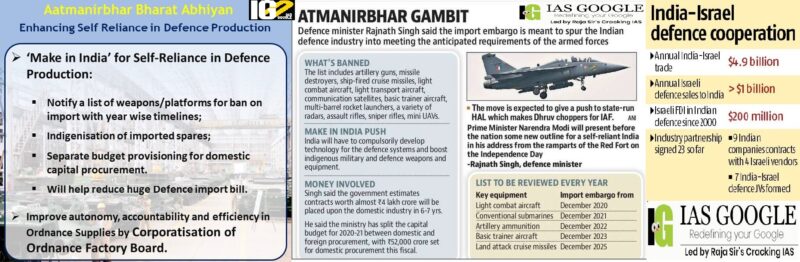
The Ministry of Defence (MoD) is laying a lot of stress on defence indigenisation, domestic procurement and defence exports. During the period 2015–2021, over 60 per cent of capital procurement contracts of the MoD by number (190 out of 304) and 43 per cent by value (Rs 1,39,038 crore out of Rs 3,21,376 crore) were secured by the domestic industry.
 Defence indigenisation?
- The capability of developing and producing any defence equipment within the country for the dual purpose of achieving self-reliance and reducing the burden of imports is defence indigenisation.
- The key objective of Department of Defence Production is Self-reliance in defence manufacturing.
- Defence Research Development Organisation (DRDO), Defence Public Sector Undertakings (DPSUs), Ordnance Factory Board (OFB) and private organisations are playing a critical role in indigenisation of defence industries.
Need for defence indigenisation?
- To make India self-reliant in defence sector. The government’s Aatmanirbhar Bharat Abhiyan (ABA) aims to unlock the potential of the domestic industry and manufacturers to meet the country’s growing requirements.
- The aim will be to foster innovation and technological development in the defence and aerospace sector.
- The aim is to procure such items from the domestic industry, within specific timeframes, while embargoing their imports.
- The aim is to achieve defence exports target of US$ 5 billion by 2025.
- India aims to become an essential part of the global defence value chain. At the same time, the aim is to reduce the country’s dependence on defence imports.
Impact on defence trade between India and Israel?
- India is Israel's third largest trade partner in Asia and seventh largest globally.
- In recent years, the bilateral trade has diversified into several sectors such as pharmaceuticals, agriculture, IT and telecom, and homeland security.
- Indian companies are marking their presence in Israel through mergers and acquisitions and by opening branch offices.
- There are over 300 investments from Israel in India mainly in the high-tech domain and in agriculture.
- Out of 90 per cent of defence imports, 8% is from Israel. The Srijan defence indigenisation portal, a limited but concrete example of the implications of India’s defence indigenisation efforts on key strategic partnerships like with Israel.
Road Ahead
- Even as the three decades old India–Israel defence partnership is set to grow and solidify in the coming future, India’s defence self-reliance drive will impact, to an extent, the quantum of the relationship.
- India’s modernisation needs are huge, as well as the need to effectively meet the growing security concerns across the internal and external spectrum.
- India and Israel have developed an all-round defence and security partnership, with increasing focus on joint development and production.
- Exports of Indian-manufactured Israeli products like unmanned aerial vehicles (UAVs) to countries in Southeast Asia is another arena of cooperation where the two countries could focus their efforts, especially by the private sector companies.
Posted on 03-02-2022 • By Admin