




Is Coronavirus giving Beijing an opening in the South China Sea?
Maritime Asia has emerged as a new geopolitical frame of reference in recent years as the nations of Asia evolve into major trading and resource-consuming powers with economic growth dependent on seaborne trade.
However, China has been aggressively expanding its maritime influence, which can be seen through its activities in the South China Sea (SCS).
The sinking of Vietnamese fishing boat (in the Exclusive Economic Zone of Vietnam) by a Chinese ship near the Paracel Islands is the recent act of aggression in the region. Earlier, China unilaterally refused to follow the ruling on SCS given by the Permanent Court of Arbitration in 2016.
These Chinese assertions in the South China Sea and its hegemonic ambitions have become a cause of concern for peace and stability in the region.
Why South China Sea?
- Geo-Strategic Location
- The geographic location of the SCS is strategically important. As it links the Indian Ocean to the Pacific and is a critical shipping channel
- According to the United Nations Conference on Trade And Development (UNCTAD), one-third of the global shipping passes through it, carrying trillions of trade.
- Roughly two thirds of South Korea’s energy supplies, nearly 60% of Japan’s and Taiwan’s energy supplies, and 80% of China’s crude oil imports come through the South China Sea.
- Rich Energy Reserves
- SCS is believed to have huge oil and gas reserves beneath its seabed.
- According to the World Bank, the South China Sea holds proven oil reserves of at least seven billion barrels and an estimated 900 trillion cubic feet of natural gas.
- Choke Point
- The Strait of Malacca connects Indian Ocean to the South China Sea and is 900 km in length and is also a prominent trade route between East Asia and West Asia-Europe.
- The Strait of Malacca is a choke point, it is always in interest of great powers to control such a strategic location. Thus, due to the presence of this choke point, SCS assumes much importance for China and other regional countries.
- In context of naval diplomacy, it is a geopolitical term used to signify an international strait whose control could potentially affect commercial transit.
- Fishery Resources
- Fishing in the South China Sea is a big business.
- According to some estimates up to 10 % of the world’s ocean-caught fish come from the region. However the fish stocks in the area are depleted and regional countries are using fishing bans as a means of asserting their sovereignty claims.
South China Dispute
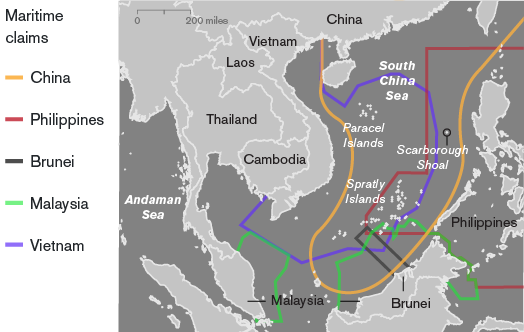
Encroaching EEZ of Other Countries
In 1947, China took control of some islets in the South China Sea occupied by Japan in World War–II. Since 1953, China has been claiming almost the entire South China Sea, reflected in a map created with a 9-dash line to show them as a part of China.
- In 2016, the Philippines had
filed an arbitration case in the Permanent Court of Arbitration, seeking
to strike down China’s expansive territorial claims in the South China Sea.
- The tribunal issued a decision finding that there is no legal basis to claim “historic rights” to islands in the South China Sea and the 9-dash line is inconsistent with Convention on the Law of the Sea.
- However, China refused to abide by the judgement.
- China has asserted a maritime
claim (based on historic rights) to a large part of the South China
Sea that is not consistent with international law.
- The SCS has more than a dozen overlapping EEZ in accordance with the 1982 Convention on the Law of the Sea (UNCLOS- an international treaty that sets out important maritime rules).
- As per UNCLOS, countries in their EEZ can explore oil, mineral resources, living and non-living natural resources including resources under the sea, seabed and subsoil.
Building Great Wall of Sand
There are many interconnected disputes over who is in charge of the various islands, rocks, shoals and reefs scattered throughout the South China Sea waters.
- The Paracel Islands are claimed by China, Taiwan and Vietnam. The Spratly Islands are claimed by China, Taiwan, Vietnam, Brunei and Philippines. The Scarborough Shoal is claimed by Philippines, China and Taiwan.
- Further, since 2010, China has been converting uninhabited islets into artificial islets to bring it under UNCLOS (examples would include Haven Reef, Johnson South Reef and Fiery Cross Reef).
- China has been changing the size and structure of the reefs by modifying their physical land features. It has also established airstrips on Parcel and Spratly.
- Chinese fishing fleets are “engaged in paramilitary work on behalf of the state rather than the commercial enterprise of fishing.
- The US is very critical of this building of artificial islands and terms these actions of China as building a ‘great wall of sand’.
Is South China Sea important for India?
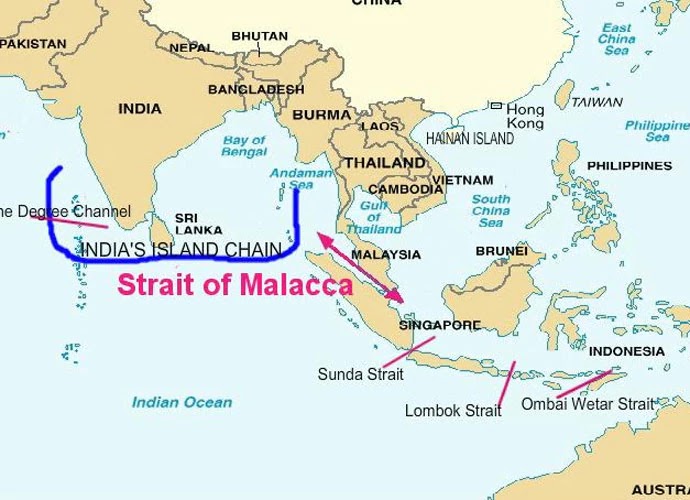
South China Sea sees a substantial level of world exchange that goes through Malacca Strait a piece of South China Sea. India's 55 % of exchange goes through Strait of Malacca which opens into South China Sea. On the off chance that China controls the district, it will agitate the worldwide exchange practices and nations like India will straightforwardly get influenced. Any antagonistic activity by China can hamper India's outside exchange going through that district. Accordingly, India has a stake in guaranteeing flexibility of route in the district. In the event that China is effective in controlling the ocean paths, India would lose universal exchange course or pay additional to China to keep it reestablished. India does not need this to happen and along these lines it is constrained to get engaged with South China Sea question to protect its financial advantages.
India has true blue key concerns on the grounds that any military clash in South China Sea will have repercussion on the Indian Ocean area. It might hamper provincial security circumstance and in such case India's association with South East Asian nations may get disturbed. So South China Sea is imperative to India from vital perspective.
India however topographically far from the South China Sea plainly keeps up a separation from any association in this question. Notwithstanding, the ongoing advancements recommend that India's enthusiasm for the South China Sea debate is over developing.
This is borne out from the declaration made by the Indian Prime Minister Narendra Modi at various stages like ASEAN Summit and his joint articulations made with a few nations like USA, Japan Philippines and Vietnam additionally particularly specifies South China Sea question.
There are couple of different variables that force India to assume a noteworthy part in South China Sea question. One in wake of debilitating American partnership in Asia, US need India to assume a part in provincial security issues, for example, South China Sea question.
Second, China's over developing desire has the chilling impact on India's security engineering and New Delhi likes to counter China by getting associated with the South China Sea question.
Third, there is worldwide sea security intrigue engaged with the district and numerous countries need India to adjust the emphatic and rising China and like it to get associated with the debate to keep up peace and security in the locale.
Fourth, India's Act East arrangement requires financial and guard ties with Southeast Asian nations and a considerable lot of them need India to assume a noteworthy part in settling the South China Sea debate. It shows up India is all the more eager to tune in to its ASEAN companions by observing its developing association in the question.
Fifth, India having a voice in a noteworthy local security issue gives its glory that comparable with its local power status. This has required India to get engaged with forming the security engineering of the Indo-pacific area. In such setting, India alongside the U.S. what's more, different forces is outfitting to assume real part as security supplier in the area.
Last however not the minimum, India's South China Sea strategy is an experiment of 'hostile guarded; remote arrangement sought after by New Delhi. It is utilized for discouraging China to keep up its hands off approach towards India. All things considered this strategy serves such constrained motivations to keep up an even association with China.
At last, despite the fact that India isn't a gathering toward the South China Sea question it has every one of the motivations to keep up peace in its terrace. This has constrained India to get engaged with South China Sea debate basically for three reasons; one to keep up sea security, second to grow close binds with ASEAN nations to satisfy its Act East arrangement and third to counter China in the Indian Ocean area.
Last, India as nonpartisan eyewitness can attest its weight on the area in organization with a few different countries to determine the South China Sea question. In such undertaking India's hostile guarded technique seems to fill its need without souring India-China relationship.
India's Stand
- India has maintained that it is not a party to the SCS dispute and its presence in the SCS is not to contain China but for its own economic interests, especially that of its energy security needs.
- However, China’s increasing ability to decide and expand its role in the South China Sea has compelled India to reevaluate its approach on the issue.
- As a key element of the Act East Policy, India has started internationalizing disputes in the Indo-Pacific region to psychological pressure on irritants (the recent mentions of South China Sea dispute in bilateral statements between India-USA and India-France is a testimony to the fact).
- Further, India is aggressively using the soft tool of Buddhist legacy to reclaim the unique historical leverage to make a strong bond with the Southeast Asian region.
- India has also deployed its navy with Vietnam in the South China Sea for protection of sea lanes of communication (SLOC), denying China any space for assertion.
- Also, India is part of Quad initiative (India, US, Japan, Australia) and lynchpin of Indo-Pacific narrative. These initiatives are viewed as a containment strategy by China.
Summing up
Today’s world comprises extensive interconnections of countries and people. Any particular conflict, therefore, has the potential to have a ripple effect on countries and institutions other than the direct stakeholders. China must realise that it cannot continue with its bullying tactics and win trust of its neighbours and respect from the International Community.It is therefore desirable that all the countries of this region should abide by rule based international order and peaceful coexistence.