




Climate change, driven primarily by the accumulation of greenhouse gases—especially carbon dioxide (CO₂)—in the atmosphere, poses an existential threat to ecosystems, economies, and societies worldwide. As nations strive to meet their climate targets under the Paris Agreement and achieve net-zero emissions, carbon sequestration has emerged as a critical strategy to remove CO₂ from the atmosphere and store it safely for extended periods. This essay explores the concept, methods, significance, challenges, and future prospects of carbon sequestration.
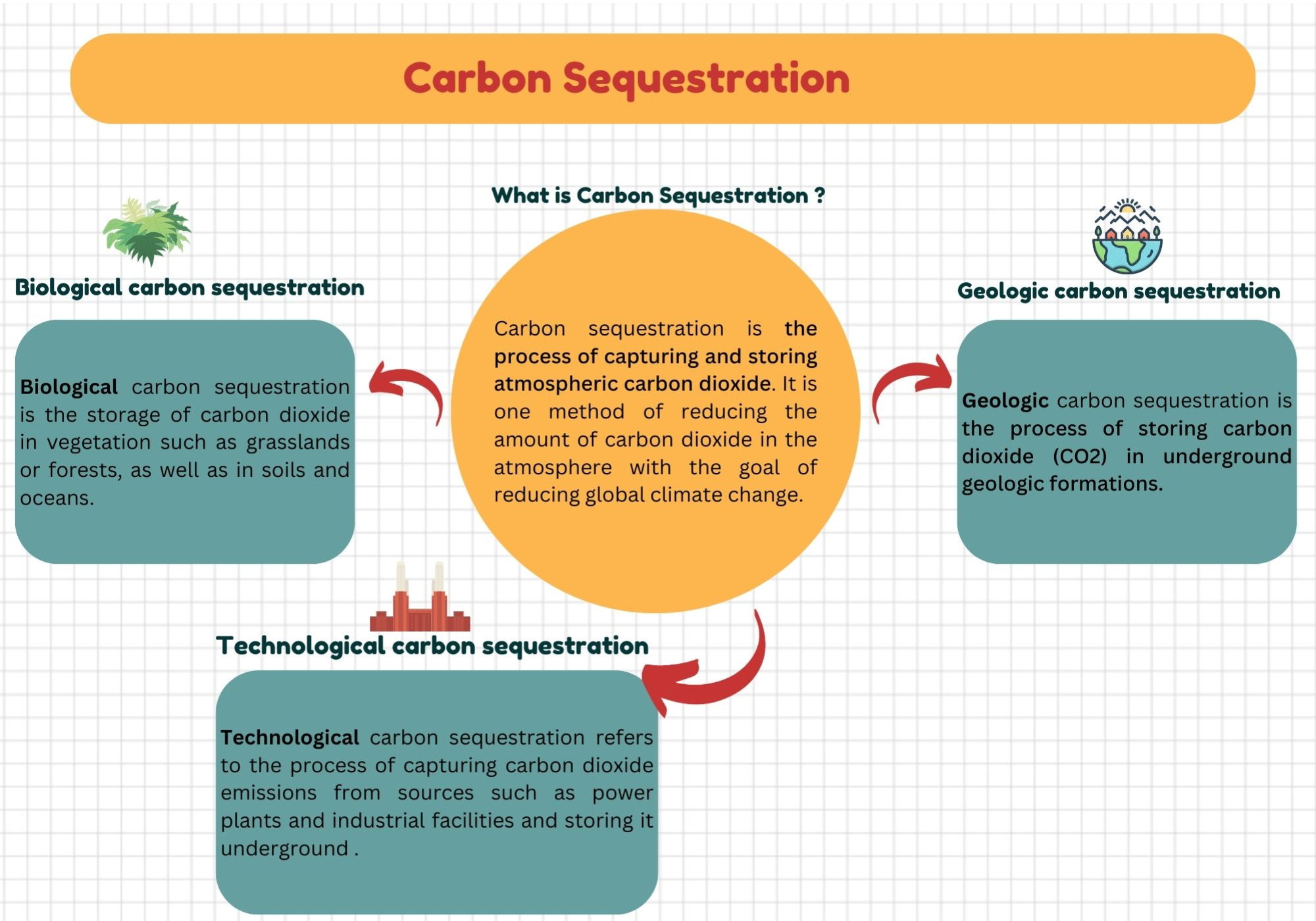
Carbon sequestration refers to the process of capturing atmospheric CO₂ and storing it in natural or artificial reservoirs to prevent its release into the atmosphere. It can occur through biological, geological, or chemical means. The goal is to offset emissions, reduce the concentration of greenhouse gases, and slow the pace of global warming.
Types of Carbon Sequestration
Biological Carbon Sequestration (Biosequestration)
This method uses natural ecosystems to absorb and store carbon through photosynthesis and organic matter accumulation.
Forests and Vegetation
- Trees and plants absorb CO₂ during photosynthesis.
- Carbon is stored in biomass (trunks, branches, leaves) and soil.
- Afforestation and reforestation are key strategies.
- Example: Amazon rainforest, Indian Green India Mission.
Soil Carbon Sequestration
- Organic practices like no-till farming, cover cropping, and composting increase carbon retention in soil.
- Soil acts as a long-term carbon sink.
- Enhances soil fertility and water retention.
Wetlands and Peatlands
- These ecosystems store carbon in waterlogged soils where decomposition is slow.
- Peatlands hold twice as much carbon as all the world’s forests combined.
- Restoration prevents carbon release from drained wetlands.
Biochar
- Produced by pyrolysis of biomass in low-oxygen conditions.
- When added to soil, biochar locks carbon for centuries.
- Also improves soil health and crop yield.
Ocean-Based Carbon Sequestration
The oceans naturally absorb about 25–30% of global CO₂ emissions. These methods aim to enhance that capacity.
Ocean Fertilization
- Adding nutrients (e.g., iron) to stimulate phytoplankton blooms.
- Phytoplankton absorb CO₂ and sink after death, sequestering carbon in deep ocean layers.
- Still experimental and controversial due to ecological risks.
Alkalinity Enhancement
- Adding substances like lime or olivine to increase ocean alkalinity.
- Boosts the ocean’s ability to absorb and store CO₂ as bicarbonates.
- Mimics natural weathering processes.
Seaweed Farming
- Seaweeds like kelp grow rapidly and absorb CO₂.
- Sinking harvested seaweed to the ocean floor can trap carbon.
- Also provides food, biofuel, and habitat benefits.
Technological Carbon Sequestration
These engineered methods are designed to capture and store CO₂ from industrial or atmospheric sources.
Carbon Capture and Storage (CCS)
- Captures CO₂ from power plants or factories.
- Injects it into deep geological formations (e.g., saline aquifers, depleted oil fields).
- Proven technology but costly and infrastructure-intensive.
Direct Air Capture (DAC)
- Machines extract CO₂ directly from ambient air using chemical filters.
- Captured CO₂ is either stored underground or used industrially (e.g., in fuels or concrete).
- Scalable but currently expensive.
Mineralization (Carbon Mineral Storage)
- CO₂ reacts with naturally occurring minerals (e.g., basalt, peridotite) to form stable carbonates.
- Mimics natural rock weathering.
- Offers permanent storage with minimal leakage risk
Future Prospects and Way Forward
To scale carbon sequestration effectively, a multi-pronged approach is needed:
- Invest in Research and Innovation: Improve efficiency and reduce costs of technological solutions.
- Strengthen Policy Frameworks: Incentivize carbon farming, biochar use, and CCS deployment.
- Promote Community Participation: Engage local populations in afforestation and soil conservation.
- Integrate with Climate Strategy: Combine sequestration with emission reduction for holistic impact.
Carbon sequestration is not a silver bullet, but it is a powerful tool in the climate action arsenal. By harnessing nature and technology, humanity can capture excess carbon, restore ecological balance, and build resilience against climate change. As the world races toward a sustainable future, carbon sequestration must be embraced not just as a scientific solution, but as a moral and strategic imperative.