



Gandhi, Ambedkar and the 1932 Poona Pact
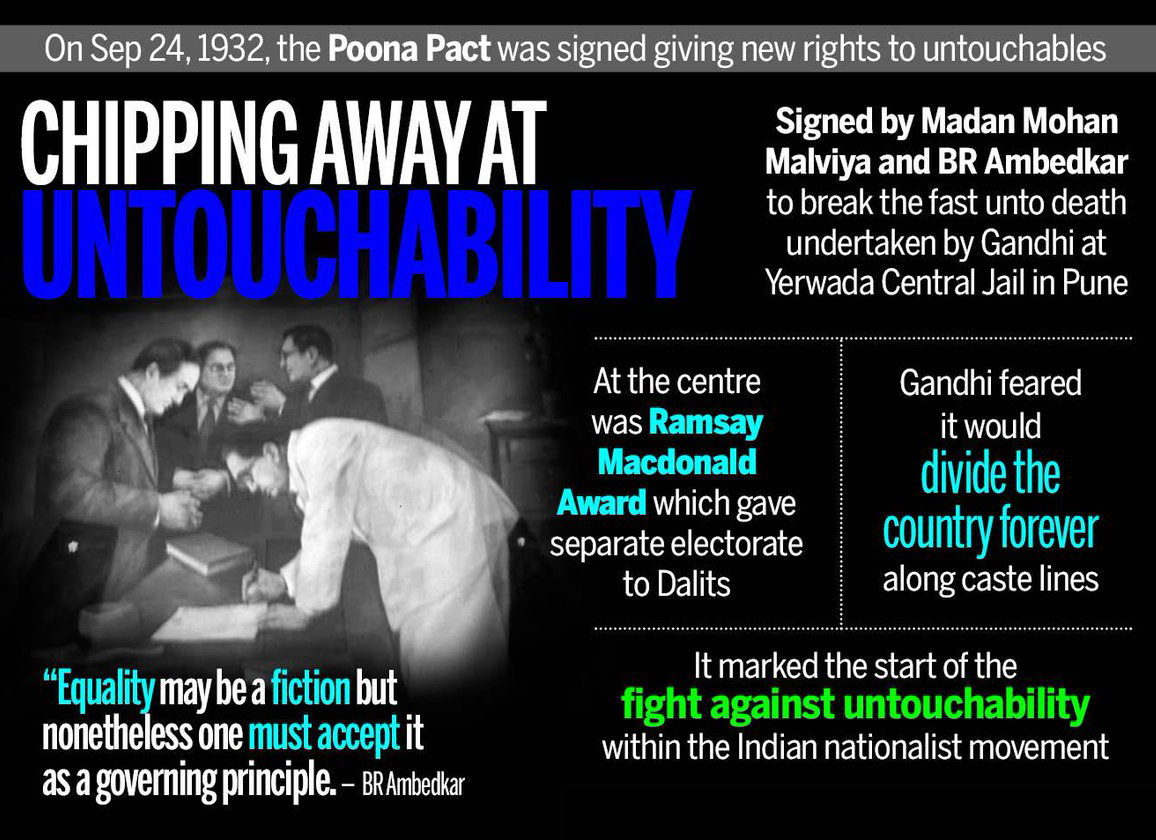
In 1932, B.R. Ambedkar negotiated the Poona Pact with Mahatma Gandhi. The background to the Poona Pact was the Communal Award of August 1932 which provided a separate electorate for depressed classes.
The pact signifies a solution derived by amalgamating two different ideologies (Ambedkar: Political Approach and Gandhi: Social Approach), striving to achieve a common goal for upliftment of one of most vulnerable sections of the Indian society.
Genesis
- On August 16, 1932, the British Prime Minister, Ramsay MacDonald, announced the Communal Award which provided for separate electorates for the ‘Depressed Classes’, the Muslims, the Europeans, the Sikhs, the Anglo-Indians and the Indian-based Christians.
- The Award of 1932 was built on the notion of separate electorates that the British government had already put in place through the Morley-Minto Reforms (1909) and the Montagu-Chelmsford Reforms (1919).
- Under a separate electorates system, each community was allocated a number of seats in the legislatures and only members from these communities would be eligible to vote to elect a representative of the same community to legislative assemblies.
- Mahatma Gandhi was bitterly opposed to the communal award, as the award in continuum of constant efforts of the British imperialists to divide Indian people into a number of special-interest groups and to weaken the national movement.
- Initially, Ambedkar was in favour of the award, as according to him political solutions like separate electorate would work for upliftment of depressed classes.
- However, after the series of negotiations both Gandhiji and Ambedkar agreed to a solution called Poona Pact and thereby withdrawing separate electorate for depressed classes.
Significance of Poona Pact
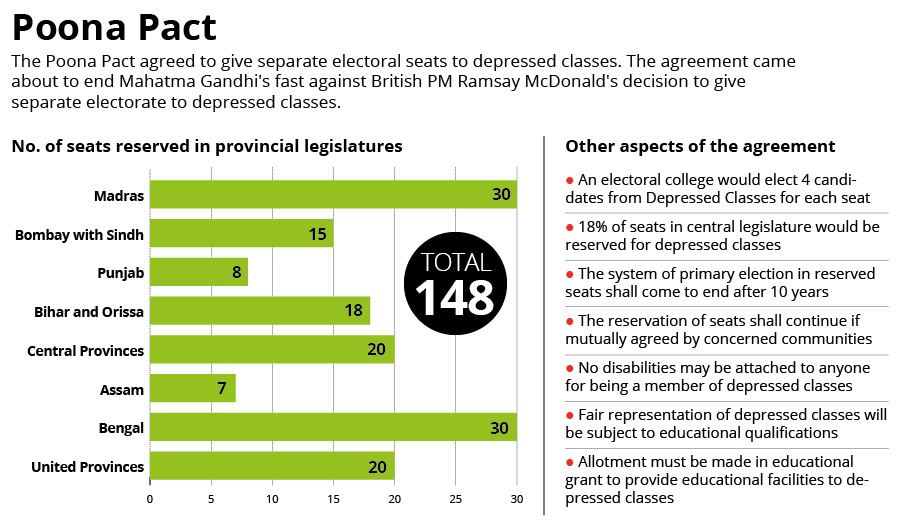
- Representation Of Depressed Classes: In a settlement negotiated with Mahatma Gandhi, Ambedkar agreed for depressed class candidates to be elected by a joint electorate.
- Also, nearly twice as many seats (147) were reserved for the depressed classes in the legislature than what had been allotted under the Communal Award.
- In addition, the Poona Pact assured a fair representation of the depressed classes in the public services while earmarking a portion of the educational grant for their uplift.
- The Poona Pact was an emphatic acceptance by upper-class Hindus that the depressed classes constituted the most discriminated sections of Indian society.
- It was also conceded that something concrete had to be done to give depressed classes a political voice.
- The pact made the entire country morally responsible for the uplift of the depressed classes.
- As the concessions agreed to in the Poona Pact were precursors to the world’s largest affirmative programme (reservation in legislature, public services and educational institutions) launched much later in independent India.
- Most of all the pact made the depressed classes a formidable political force for the first time in Indian history.
Note:
- Madan Mohan Malaviya signed it on behalf of Gandhi.
- Instead of the 80 seats given by the British, the depressed classes got 147 seats.
- The Communal Award was based on the findings of the Indian Franchise Committee, called the Lothian Committee.
Gandhi And Ambedkar: Difference in Approach
Both the leaders were critical of ills pertaining to the caste system and committed to the upliftment of depressed classes. However, both differ in the approach.
- Ambedkar was in favour of annihilation of the caste system as it was beyond reforms.
- Gandhi did not support the abolition of the caste system or Varnashrama order. He was in favour of bringing behavioural change in the society regarding the ills of the caste system.
- According to Ambedkar, the caste question is a political issue and wanted a political solution for upliftment of depressed classes. Ambedkar insisted that a political democracy was meaningless if the so-called depressed classes were not equal participants in it.
For Ambedkar, the idea of citizenship included depressed classes participating in the electoral process with equal voting rights. Most importantly for Ambedkar, the ability of the depressed classes to elect their own representatives was a way to achieve full potential of democracy. For this, voting in an electorate free from the influence of caste Hindus was required.
- According to Gandhi caste issue is a social one. He wanted to reform it by changing the hearts and minds of people.
- Ambedkar preferred a rights-based approach while Gandhi’s approach was through faith and spirituality.
- That's why Ambedkar's referred depressed classes as dalits (to give them a political identity), on the other hand Gandhi called depressed classes as Harijan (to sensitize upper caste for plight of depressed classes by invoking spirituality).
Summing up
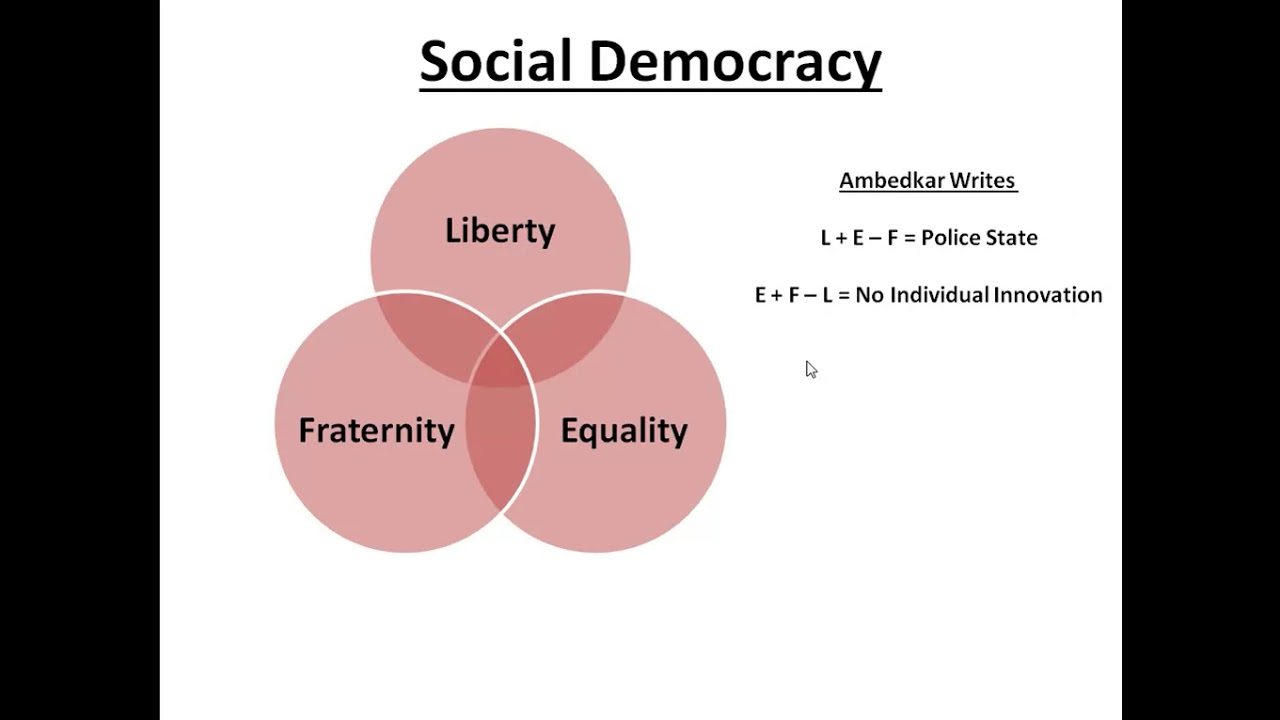
The Poona Pact has changed the Indian Political history and the destiny of millions of Dalits across the country. However, social stigma attached to the caste system still remains in the Indian society. Therefore, in order to establish an egalitarian society in true sense, Gandhian Philosophy and Ambedkar’s notion of Social Democracy is much more relevant than ever before.