



News Information Bureau | 23rd July 2020
|
Subcritical, Critical, Supercritical When a U-235 atom splits, it usually gives off two or three neutrons. If there are other U-235 atom nearby, then one of three things happens:If exactly 1 free neutrons from each fission hits another U-235 nucleus and causes it to split, then the mass of Uranium is said to be critical. The mass will exist at a stable temperature. A nuclear reactor must be maintained in a critical state. If less than one of the free neutrons hits another U-235 atom, then the mass is subcritical. Eventually, induced fission will end in the mass.If more than one of the free neutrons hits another U-235 atom, then the mass is supercritical. It will heat up. In a nuclear reactor, the reactor core needs to be slightly supercritical so that the plant operators can raise and lower the temperature of the reactor. The control rods give the operators a way to absorb free neutrons so that the reactor can be maintained at a critical level. 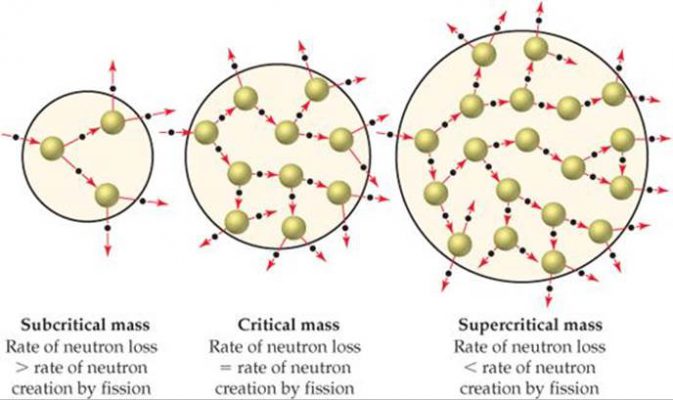 |
- The Kakrapar atomic power station is located on the banks of the Tapti River, approximately 80 km from the city of Surat, Gujarat.
- Developed and operated by Nuclear Power Corporation of India (NPCIL), the two pressurised heavy water reactors (PHWR) are the first set of indigenous-led plants to be developed in India.
- The first two 220MW capacity KAPS-1 and KAPS-2 units were commissioned in May 1993 and September 1995 respectively.
- KAPP-3 and KAPP-4 were expected to begin operations in 2019 and 2020 respectively. However, KAPP-3 has started its operations now. Soon, KAPP-4 will follow the suit. Both KAPP-3 and KAPP-4 have a capacity of 700MW each. Construction of units 3 and 4 started in November 2010.
- The Kakrapar nuclear power plant was recognised as the best performing PHWR by CANDU Owners Group (COG) in 2003.
- The first stage programme consists of setting up of pressurised heavy water reactors (PHWRs). PHWRs are natural uranium-fuelled, heavy water moderated and cooled. The uranium reserves in the country are adequate to support the first stage nuclear power programme of 10,000 MWe through PHWRs. In addition to generating power, PHWRs progressively make available plutonium as a by-product. The technologies for the reprocessing of plutonium from spent PHWR fuel and for fabrication of plutonium bearing fuels have been systematically established in India through research and development over the past several years.
- The second stage of the nuclear power programme consists of effective utilisation of plutonium in Fast Breeder Reactors (FBRs) which will provide the key to full utilisation of the country’s uranium resources and prepare the way for the long-term utilisation of the more abundant thorium reserves. FBRs enable generation of more fresh fissile material than is consumed for power production. With the deployment of FBRs, the depleted uranium and plutonium generated in the first stage will permit an additional power potential to the extent of 3,50,000 MWe.
- During the later part of the second stage programme, it is proposed to use thorium as blanket material in FBRs to generate U-233, another fissile material for use in the third stage programme based on U-233 fuelled reactor systems.
- Stage-I: envisages, construction of Natural Uranium, Heavy Water Moderated and Cooled Pressurised Heavy Water Reactors (PHWRs). Spent fuel from these reactors is reprocessed to obtain Plutonium.
- Stage-II: envisages, construction of Fast Breeder Reactors (FBRs) fuelled by Plutonium produced in stage-I. These reactors would also breed U-233 from Thorium.
- Stage-III: would comprise power reactors using U-233 / Thorium as fuel.
- The Quad traces its origins to the great Asian tsunami of December 26, 2004. Indian ships, aircraft and helicopters were dispatched within hours to assist Sri Lankan, Maldivian and Indonesian neighbours in distress.
- This swift response established our navy’s credentials as a credible regional force. On the other hand, not a single PLA Navy (PLAN) ship was seen throughout the 2004 tsunami relief operations.
- Later, when navies of five nations assembled for a joint exercise off Okinawa, China issued a demarche to India, US, Japan and Australia seeking details about their meeting — terming it a “Quadrilateral initiative”. China’s hostility arouses trepidation amongst Quad members.
- The time for ambivalence is over and while India will have to fight its own territorial battles with determination, this is the moment to seek external balancing.
- A formal revival and re-invigoration of the Quad is called for. It is also time to seek an enlargement of this grouping into a partnership of the like-minded.
- Other nations feeling the brunt of Chinese brawn may be willing to join an “Indo-Pacific concord” to maintain peace and tranquillity and to ensure observance of the UN Law of the Seas.
- He states that it is essential for India’s strategic-planners and policy-makers to retain clarity about the reason India has become a partner that is sought after by the US and others.
- While India’s status as a nuclear-weapon state and major land/air power, as well as a growing economy and attractive market, has been known for some time, New Delhi’s newfound allure for the US, the Quad and ASEAN is rooted only in its ability to project power and influence in distant ocean reaches.
- Finance Minister Nirmala Sitharaman had said that the proposed policy would notify the list of strategic sectors requiring the presence of at least one state-owned company along with the private sector.
- In all other sectors, the government plans to privatise public sector enterprises, depending upon feasibility. The number of enterprises in strategic sectors will be only one to four, and others would be privatised/merged/brought under a holding company structure.
- The government has already set in motion privatisation plans for large PSU companies BPCL, Air India, Container Corporation of India, and Shipping Corporation of India.
- The emphasis on privatisation could see companies in chemicals and infrastructure space being privatised, while the government has stated its intent to reduce the number of state-owned banks. This could see some smaller banks being privatised in due course.
- A holding company structure could also be used to house equity of smaller banks in one entity. The government has shifted its focus to having a few very large banks under its fold, and a decision regarding the smaller banks is expected after the policy is unveiled.
- One, a Euro 1.1 trillion budget for the EU over the next seven years.
- Two, Euro 360 billion in low-interest loans for countries most hit by Covid-19.
- Three, Euro 390 billion in grants to the worst affected economies.
- One is, of course, its size — roughly $2 trillion or Rs 150 lakh crore or 75 per cent of India’s annual GDP.
- Secondly, instead of individual countries raising funds, this time around, the EU as a whole will borrow money from the markets — a total of Euro 750 billion (for grants and loans). This is a radical departure —economically as well as politically — from the past.
- Thirdly, the EU will be able to impose taxes in the region to partially pay for the fund. This, along with the Budget details, will entail an unprecedented level of fiscal coordination among the member states for the next seven years.
- Fourthly, almost a third of the overall package — Euro 500 billion — has been earmarked towards countering climate change. This includes expenditure towards developing clean energy, its use via emissions-free cars and other such technologies, as well as promoting energy efficiency.
- In terms of the EU’s GDP, this agreement’s size is roughly 5 per cent. Given that the economy is likely to contract by more, this deal is just the first step in terms of resuscitating the ailing economies of the region. Not to mention the fact that this deal still requires member states to ratify it.
- Even after ratification, implementation will be another kettle of fish, because many countries such as Hungary and Poland may resist the reforms agenda that many of these grants and cheap loans might entail.
- However, the political significance of the deal cannot be overemphasised.
- In the aftermath of the 2008 crisis, several EU countries found that, thanks to high levels of national debt and their abysmal sovereign rating, they could not raise loans from the markets at affordable interest rates.
- So, the EU had created the European Financial Stability Facility (EFSF), which essentially worked as an intermediary between the investors (who got more security for their investment) and the heavily-indebted EU countries (who got loans at lower rates).
- The EFSF and the European Stability Mechanism, which succeeded it in 2013, together disbursed Euro 255 billion in loans.
- The current structure is significantly different in that it allocates nearly Euro 400 billion in grants, apart from Euro 360 billion in loans. Moreover, the loans do not come stapled with demands of fiscal austerity — they are likely to ask, however, for certain basic rule of law to be adhered to.
- A serological survey is done to detect the presence of specific antibodies, and is used to assess the prevalence of a disease in the population.
- The test indicates past infections (and which triggered an immune response), and is not used to detect active infections.
- A serological test is performed to diagnose infections and autoimmune illnesses. It can also be conducted to check if a person has developed immunity to certain diseases.
- The test detects antibodies in blood samples. ELISA is routinely used for detecting HIV infection.
- The ELISA test was used to screen 21,387 samples to understand the extent of spread of the virus in the community.
- Since the ELISA test is based on detection of antibodies, it can only help in knowing if the person has been previously infected by coronavirus.
- The virtual Summit featured high-level presence from Indian and US government policymakers, state-level officials, and thought leaders from business and society.
- Other key speakers at the Summit included Minister of External Affairs Dr. S Jaishankar and U.S. Secretary of State Mr. Mike Pompeo.
- The India Ideas Summit was held virtually by the US Chamber of Commerce.
- Formed in 1975, the US-India Business Council (USIBC) represents top global companies operating across the United States and India.
- USIBC serves as the premier voice of industry, creating connections between businesses and governments in both countries.
- USIBC is also part of US Chamber of Commerce. The Council’s mission is to promote trade relations between India and the United States.
- Council supports pro-growth policies and increased bilateral engagement, focusing in two-way trade.
- It aims to create an inclusive bilateral trade environment between India and the United States by serving as the voice of industry, linking governments to businesses, and supporting long-term commercial partnerships. This will nurture the spirit of entrepreneurship, create jobs, and successfully contribute to the global economy.
- USIBC organises roundtables and business summits featuring heads of states from India and the United States, members of the U.S. Congress, members of the Indian Parliament, and notable influencers in the U.S.-India commercial corridor.